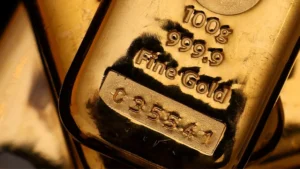


Gold prices continue their sideways movements in global markets, in light of the inability of an ounce to breach the $4,200 barrier, and despite declining expectations regarding raising US interest rates during the current month. This performance comes amid cautious anticipation of developments in the conflict in the Middle East and its expected repercussions on oil prices.
On the technical level, gold prices are facing resistance levels starting at $4,150, followed by $4,180, and reaching $4,200 in the event of new purchasing liquidity. On the other hand, the ounce receives support levels at $4,083, then $4,070, reaching the $4,000 level that enhances selling pressure.
Regarding trading strategies, the technical vision recommends that near-term investors avoid selling at the present time due to the severity of volatility, while long-term investors are advised to seize opportunities at the $4,070 level with the return of purchasing liquidity, and target gains near the $4,400 level.
In the futures market, buyers are seeking to push prices beyond the $4,325 level, while sellers are pressing to break the $4,015 level. Technical resistance levels for futures are located at $4,175 then $4,200, while support levels are located at $4,100 then $4,090.
For its part, ANZ Bank analysts explained that concerns related to public finances and debt sustainability make the rise in bond yields an indication of the need to hedge with gold more than an indication of the strength of growth, which supports the positive outlook for the yellow metal in the long term. Analysts pointed out that the strength of the dollar and rising yields may impose short-term pressures that lead to potential selling waves before achieving a sustainable rise.
The report also added that strong demand from Chinese investors – driven by weak stock and real estate markets – along with central banks’ continued efforts to diversify reserves, supports the market’s prospects. Accordingly, ANZ Bank expects gains to remain limited in the short term, before prices exceed the threshold of $5,000 per ounce by 2027, supported by investment demand and central bank purchases, coinciding with anticipation of the path of US interest rates and the dollar.