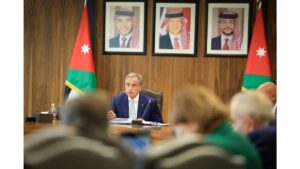
The Governor of the Bank of Lebanon, Karim Saeed, revealed that approving the financial gap law may require between 6 and 8 months, in light of the continuing observations that prevent reaching a final formula that is agreed upon by the Lebanese authorities and the International Monetary Fund.
Saeed said, in an exclusive interview with CNN Economic, that the draft law came out of the government at the end of 2025, but the Bank of Lebanon recorded comments on it, in addition to “strong observations” made by the International Monetary Fund.
He explained that work is underway to unify the vision, expecting to refer an agreed-upon formula to the House of Representatives by the end of September, but he ruled out the issuance of the law before 6 to 8 months, based on the pace of passing laws in Lebanon.
The Financial Gap Law, also known as the Financial Regularity and Deposit Recovery Law, is an essential step in the process of addressing the financial collapse that has been ongoing since 2019, as it is supposed to determine the size of losses, how to distribute them, and the mechanism for depositors to recover their money, after the amendments to the Banking Reform Law were approved in August.
Regarding the deposits file, Saeed announced that the Bank of Lebanon’s obligations towards banks and depositors amount to about 79.5 billion dollars, and may decrease to approximately 79 billion dollars by the end of the year, while the cumulative payments to depositors under Circulars 158 and 166 amounted to about 6.1 billion dollars.
He pointed out that what he described as “impurities” within the liabilities recorded in the Bank of Lebanon’s budget may reach 30% of their value, explaining that the remaining amounts after the audit can be paid to depositors in cash over several years or through bonds.
The Bank of Lebanon uses the term “impurities” to refer to claims it considers unjustified, including deposits of unknown origin, and book transfers from the lira to the dollar carried out after the outbreak of the crisis without actual coverage, in addition to interests it describes as inflated. The mechanism for sorting these amounts and determining responsibility for them remains one of the most prominent points of disagreement between depositors, banks, and the state.
Regarding the gold reserve, Saeed confirmed that he opposes its sale in principle and without a specific framework, but he did not rule out raising the issue if the Bank of Lebanon faced an urgent obligation towards depositors that it could not fulfill.
He stressed that gold is not intended to finance state projects or to pay its obligations or the obligations of banks. The Governor of the Bank of Lebanon alone does not have the authority to make the sale decision, as Law No. 42 issued in 1986 prohibits the disposal of the Bank’s gold assets directly or indirectly, except in accordance with a legislative text issued by the House of Representatives.
Saeed pointed out that the bank owns real estate and other financial assets that it can rely on to meet its obligations, expressing his hope that the improvement of the political situation will allow avoiding the sale of basic assets.
Regarding the foreign assets appearing in the balance sheet of the Bank of Lebanon, which amount to about 12 billion dollars, he explained that they do not represent a free reserve owned entirely by the bank, but rather include the mandatory reserves that the banks deposit with it, in addition to the deposits of the Lebanese state.
He said that it is not possible to determine a fixed level below which one should not go in light of the crisis and war, praising the performance of the Ministry of Finance in improving collections and reducing spending, describing this as “financial discipline.”
Regarding the lira file, Saeed distinguished between the stability of the exchange rate and the official stabilization policy, saying: “Today we are facing a stabilization of the lira, not a stabilization of it.”
He linked the continuation of this stability to the demand for the local currency to pay taxes, explaining that the state’s collection of about $6 billion annually in Lebanese pounds creates a demand for it and helps maintain stability.At cash.
As for the possibility of deleting zeros from the Lebanese currency, he believed that this decision dates back to a later stage, stressing that the current circumstances do not allow it to be put forward as a priority. He compared the situation to Syria, where the war ended, while Lebanon is still facing war and restrictions that limit the flow of foreign investments.
Regarding Lebanon’s inclusion on the European Union’s list of high-risk countries, Saeed considered that exiting the watchlists is not only a political or legal issue, but also constitutes a regulatory challenge.