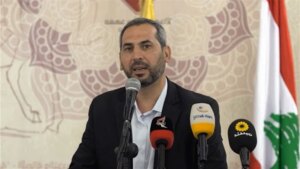
Sheikh Ahmed Qabalan delivered the Friday sermon at the Imam Hussein Mosque in Burj el-Barajneh, in which he addressed the political situation in Lebanon and regional developments.
Qabalan said that “the political situation in the country today is very complex,” considering that the current authority “deals with the south, the suburbs, and the Bekaa as if they were enemy areas,” and, according to him, is adopting policies of “siege, tracking, gathering information, and various ambushes” that affect more than half of Lebanon’s area and its people, attributing this to “its obligations and subordination to Washington and its allies.”
Qabalan addressed his speech to the executive authority, saying that the state’s role is not to “preserve the cartels of banks, power contractors, security deals, and Zionist media dens,” but rather to protect “its interests, sovereignty, security of its people, markets, resources, and contributions,” and to work to confront the crisis that is ravaging the country.
He added that “the nation is a citizen,” considering that what is happening in the south reveals, as he put it, “the falsity and failure of authority,” stressing that the state’s role must be based on “sovereignty and national, rescue, relief, and defense services.”
He continued: “Lebanon will be built with national justice, solidarity, sovereignty and development, and not with enmity against the south, the suburbs and the Bekaa and the destruction of national ties.”
He also said: “A state that evades the southern fronts is not a state,” considering that the authority that “mortgages its political, security and sovereign decisions to Washington and others is not legitimate,” and accused it of acting according to “commitments that conflict with the core concept of the state.”
Qablan pointed out that, in his opinion, the “Framework Agreement” represents a waiver of security and sovereignty in favor of Israel, describing the authority as “failed, lazy, and alien to its country and its people.”
Regarding the regional issue, he said that the region is “deeply divided” and that the Middle East is facing “radical transformations,” considering that the nature of the region is changing, and that “the interest of Arabs and Muslims is with Iran, not with America.”
He concluded by stressing that “Lebanon cannot be outside the sovereign regional interests that strongly conflict with the interests of Washington and Tel Aviv in the region.”