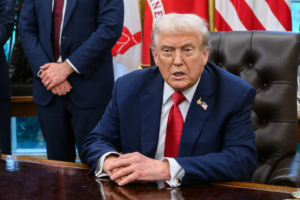
On Tuesday, US President Donald Trump reopened the Greenland file, stressing that control of the island should go to the United States and not to Denmark, coinciding with the NATO summit in Turkey.
Trump said, while speaking to reporters on the sidelines of his meeting with Turkish President Recep Tayyip Erdogan, that “Greenland should be under the control of the United States, not Denmark,” considering that this issue negatively affected his relationship with NATO.
He added: “This is what hurt my relationship with NATO. Greenland is not of benefit to Denmark, and Denmark is not spending money to actually help Greenland. This is an important area for the United States, and it is surrounded by Chinese and Russian ships.”
Trump continued, criticizing the allies’ position: “They will not agree to this with all the money we spend to help them confront Russia.”
Trump’s repeated statements about his desire for the United States to acquire Greenland, a semi-autonomous Danish region, have raised tensions between Washington and Copenhagen, and have also raised broader concerns within Europe, given the sensitivity of compromising the sovereignty of territories linked to a NATO member state.
US Secretary of State Marco Rubio said in June that talks with Denmark and Greenland continue on a monthly basis, an indication that the issue is still present in diplomatic discussions between the parties concerned.
Last May, the US special envoy to Greenland, Jeff Landry, said that Washington needed to re-establish its presence in the autonomous Danish region.
Trump believes that Greenland is necessary to ensure the national security of the United States, warning that it may fall into the sphere of Chinese or Russian influence if Washington does not strengthen its control and presence there.
Greenland holds great strategic importance for the United States, as the shortest path for ballistic missiles from Russia to American territory passes through the North Pole, and it is also believed to contain unexploited rare earth minerals.
The importance of the island increases with the melting of polar ice and the emergence of new shipping routes in the Arctic region, making it an advanced point of competition between major powers, especially the United States, Russia, and China.
At the height of the Cold War, Washington had 17 military facilities in Greenland, but it gradually closed them over time, and today it has only one facility left, which is the Petovik base in the north of the island.
Press reports indicated that the United States wants to open 3 new bases in southern Greenland, as part of its efforts to strengthen its military presence in the Arctic region.
A defense agreement concluded in 1951, and updated in 2004, allows the United States to increase the deployment of forces and military facilities on the island, provided that the authorities of Denmark and Greenland are informed in advance.
Although Trump had withdrawn his previous threats to annex Greenland in January, a US-Danish-Greenland working group was formed to discuss US concerns related to Russian and Chinese influence.
Trump’s new statements bring the issue back to the forefront at a sensitive time, as NATO leaders meet in Turkey amid internal tensions between allies, disagreements over defense spending, the war with Russia, and the future of security in the Arctic.
Between the military dimension, geographical location, and unexploited natural resources, Greenland appears to Trump to be more than a distant island, but rather a strategic card in the struggle for global influence, which explains his insistence on re-presenting it despite Danish and European objections.