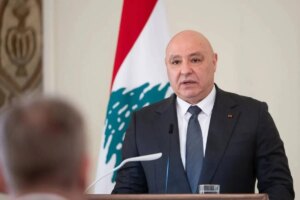
The head of the Amal Movement’s executive body, Mustafa Al-Fouani, considered that the speech of Parliament Speaker Nabih Berri on the 48th anniversary of the disappearance of Imam Musa al-Sadr and his two companions was not just a speech on an occasion, but rather constituted a “national road map” at a very sensitive Lebanese moment, and a political message that defines the constants associated with protecting the nation, its sovereignty, and its unity.
Al-Fouani said, during a media interview: “President Berri has repositioned national constants at the forefront of the scene, stressing that civil peace, national unity, and the Lebanese army are red lines that should not be crossed,” stressing the need to protect Lebanon from attempts to tamper with its internal unity or exploit the division to target it.
He explained that Israeli targeting is not limited to a party, movement, or sect, but rather affects Lebanon, its unity, and its civil peace, considering that confronting it requires a national approach far removed from regional, partisan, and sectarian calculations.
He stressed that the south is not a divisible area, a testing area, or a security belt for anyone, but rather an integral part of Lebanon, pointing out that its people were not advocates of war, but rather protectors of the land and at the forefront of the victims of the Israeli attacks that have continued since 1948.
Al-Fouani believed that Berri put the issue of sovereignty in its natural place, refusing to dispose of Lebanese rights or suspending them under any name, and adhering to Lebanon’s right to sue Israel for the destruction, killing and displacement it committed, stressing that this right does not lapse through negotiation or the passage of time.
He wondered about the results of 7 rounds of negotiations in light of the continued Israeli expansion and the high level of destruction and number of martyrs, considering that Berri’s rejection of the framework agreement and his warning against direct negotiation without a national consensus reflect a clear position on the current path.
He stressed that adhering to the Taif Agreement protects Lebanon from partition and federalization projects and restructuring the regime on the basis of division, warning that departing from Taif at this stage constitutes an adventure that threatens civil peace, sovereignty, and Lebanese territorial integrity.
Al-Fouani stressed that the invocation of Imam al-Sadr came as an invocation of his idea, will, and project, and that the slogan “Homeland Trust” means putting Lebanon first, preserving the south in the heart of the nation, and protecting national unity and sovereignty.
Regarding the case of the absence of Imam al-Sadr and his two companions, he considered that the Libyan authorities’ continued non-cooperation requires continuing judicial, legal and national efforts to uncover the truth, stressing that the case is not subject to statute of limitations and is not closed by procrastination.
Al-Fouani extended his greetings to the participants in the commemoration and events, the media, and the members of the movement and its supporters, announcing the continuation of activities in Lebanon and the countries of diaspora, until the truth is revealed and Lebanon preserves one unified homeland with the South at its heart.