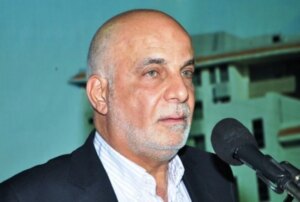
Deputy Prime Minister Tareq Mitri confirmed that legal restrictions still prevent official Lebanese action before the International Criminal Court to sue Israel, given that Lebanon is not a party to the Rome Statute establishing the court.
Mitri’s position came during a dialogue session held by the “Arab Center for Research and Policy Studies” in Beirut, entitled “Israeli Violations of International Humanitarian Law,” with the participation of MPs Inaya Ezz El-Din, Ibrahim Mneimneh and Michel Moussa.
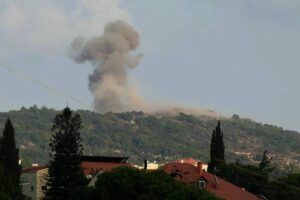
The session focused on the process of documenting Israeli violations during the recent war on Lebanon, the methodology adopted by the National Committee for International Humanitarian Law in collecting and verifying information, and the legal options available to prosecute those responsible.
Director of the Arab Center for Research and Policy Studies in Beirut, Nasser Yassin, said that the Center has been working since the beginning of the last war to shed light on Israeli violations and their direct and indirect cost on vital sectors in Lebanon.
He explained that the center held sessions and workshops, and prepared reports and research papers that dealt with the damage caused to the education, health and agricultural sectors, stressing the need to activate respect for international law and protect civilians and workers in the health and humanitarian fields.
Yassin added: “We must come to our senses in a world that normalizes genocide in all its forms, as if what is happening in Gaza and Lebanon has become acceptable.”
For his part, Mitri addressed what he described as Israel’s crimes and violations of international human rights law, recalling the threats of Israeli officials to make Lebanon “another Gaza.”
He spoke about the cultural and environmental damage to which Lebanon was exposed, and about the necessity of documenting crimes and violations in preparation for prosecuting Israel, calling on civil society organizations, civil society organizations, and all parties that prepared documented reports to share them with the government.
Mitri stressed the need to unify official and civil efforts to enrich the reports that the government is preparing, praising the volunteers in the National Committee for International Humanitarian Law who continue documentation work without compensation.
He revealed that the government is working to establish a permanent center that will collect information, document violations, and preserve evidence, to ensure the continuity of this mission and not remain linked to temporary initiatives or individual efforts.
Regarding the International Criminal Court, Mitri explained that Lebanon’s failure to join the Rome Statute prevents the state, in the current circumstances, from resorting directly to the court to sue Israel.
He pointed out that the court can, within specific mechanisms and circumstances, accept its jurisdiction to consider crimes committed within a certain period of time, even if the country in question has not fully joined the Rome Statute.
He recalled that the previous government had agreed to join the Rome Statute before retracting its decision, which prevented the completion of procedures that could have allowed Lebanon to open this judicial path.
He pointed out that the current government was unable during the past year to reopen the file or return to the accession decision, which kept legal restrictions in place for any official Lebanese action before the International Criminal Court.
Mitri stressed that the state’s inability to resort to court at the present time does not negate the right of Lebanese individuals to pursue Israel before some European courts, including courts in Spain, Belgium, and France.
He explained that some European judicial systems allow, under specific conditions, the filing of lawsuits related to international crimes or serious violations, noting that a number of people have already begun to take steps in this direction.
In turn, MP Inaya Ezz El-Din stressed the importance of protecting intangible heritage, collective memory and cultural identity, considering that their destruction targets the roots of societies and leaves losses that are difficult to compensate for.
She indicated that she had previously called, in a speech before UNESCO, for training local expertise specialized in documenting heritage and recollecting and preserving its elements.
She criticized the performance of the Lebanese negotiators, calling for adopting a more efficient legal and historical approach, and not separating the current Israeli attacks from their historical context when confronting the Israeli narrative.
For his part, MP Ibrahim Mneimneh stressed that documenting attacks constitutes an essential part of the process of obtaining rights, and helps establish the authority of international law as a cover that Lebanon cannot abandon.
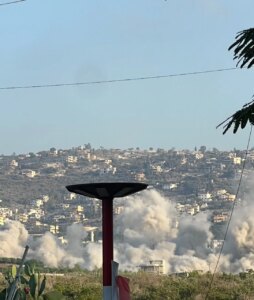
He said that the destruction of villages and town landmarks in the south expresses Israel’s violation of international standards and laws, calling for the establishment of a clear and unified framework for documentation to enhance the possibility of benefiting from evidence in legal paths.
At the conclusion of the session, Yassin called for unifying documentation efforts in different sectors, and suggested establishing a coalition or coordination framework that brings together official bodies and civil society organizations, in a way that prevents the dispersion of information and enhances the effectiveness of legal files.
The documentation process is of fundamental importance in cases related to international law, as lawsuits require identifying facts, victims, places, dates, and the nature of targets and damages, and linking them to verifiable material evidence, testimonies, and reports.