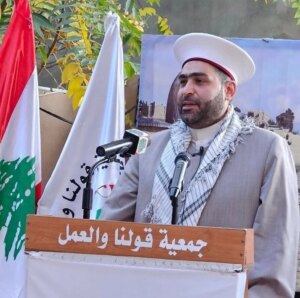
Member of the “Development and Liberation” bloc, MP Ali Khreis, rejected direct negotiations with Israel, the experimental areas, and the framework agreement, considering that the solution lies in exerting serious pressure that leads to a complete Israeli withdrawal and the deployment of the Lebanese army on all Lebanese lands and the southern border.
Khreis’s position came during a memorial ceremony in the town of Badiyas, in which he called for strengthening internal cohesion and national unity to confront external threats, especially the ongoing Israeli attacks on Lebanon.
Khreis recalled Imam Musa al-Sadr, saying that he laid the necessary foundations for building a solid homeland, and established the concept of Lebanon as a final homeland for all its people, and the principle of preserving the entire area of the country, amounting to 10,452 square kilometers, in addition to building a strong state with its people and institutions.
He pointed out that Al-Sadr considered the presence of sects in Lebanon a blessing, while sectarianism constituted a curse and a cause of crises. He also saw that maintaining internal civil peace represented the best form of confrontation with Israel.
Khreis described the stage that Lebanon is going through as one of the most dangerous stages in its history, in light of the continuing Israeli raids, pointing to the attacks that targeted Arabsalim, Nabatieh Al-Fawqa, Al-Mansouri, and dozens of southern villages.
He said that more than 60 towns and villages were completely destroyed, criticizing what he described as the silence of major powers, the Security Council and the United Nations, and the absence of international positions condemning the attacks.
Khreis wondered about the fate of Resolution 1701 issued in 2006, and about the role played by UNIFIL forces in the south, in light of the decisions related to ending the work of the international emergency forces, asking about the alternative that will be adopted after the end of their mission.
He believed that the direct negotiations did not achieve any results, wondering about the fate of the framework agreement and the experimental areas, and pointing out that the hopes placed on the last Rome session to bring about Israeli withdrawals from some villages were not fulfilled.
He added that field developments went in the opposite direction, citing what was happening in the town of Al-Mansouri, which he said was not among the towns under Israeli control, before Israeli vehicles entered it and carried out destruction and bombing operations there.
Khreis confirmed that his bloc announced from the beginning its rejection of direct negotiations, the experimental areas, and the framework agreement, stressing that what is required is to put serious pressure on Israel to force it to withdraw from all Lebanese territories.
He called for the deployment of the Lebanese army throughout the entire Lebanese territory and along the southern border, stressing the necessity of adhering to internal unity and the formula of coexistence.
He concluded by calling for the Lebanese to read from “one book, not two books,” recalling the positions of Parliament Speaker Nabih Berri calling for protecting national unity as an essential element in fortifying the interior.
Khreis’ positions come in light of a continuous field escalation in the south, which included Israeli raids on Arabsalim, Nabatieh Al-Fawqa, Al-Mansouri, Bara’shit, the vicinity of Al-Dabsha, Ali Al-Taher, and Wadi Al-Saluki, in addition to artillery shelling targeting Wadi Al-Hujair and movements of Israeli vehicles near a number of border towns.
These positions also coincide with the continuing internal debate regarding the negotiation process, the mechanism for dealing with the Israeli presence in southern regions, the future of UNIFIL, and the role of the Lebanese army in spreading and establishing stability along the border.