Samer Areej – Lebanon Today
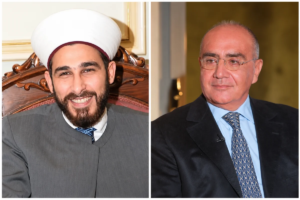
In light of a delicate phase that the Druze sect is experiencing, the speech of the supreme spiritual authority, Amin Al-Sayegh, came to go beyond its traditional religious dimension, and turned into a political-existential position that reflects the extent of concern about the contradictory paths that have begun to surround the sect, whether in Suwayda or in Lebanon.
The Sheikh’s speech, even if it came in philosophical and spiritual language, contained in its essence a clear attempt to reset the compass, at a moment witnessing a sharp division between two major projects within the Druze house.
This division is represented, on the one hand, by the path led by Sheikh Hikmat Al-Hijri in Suwayda, after the bloody events that Suwayda witnessed and the massacres and displacement that accompanied them. This path tended towards searching for external protection, reaching the point of seeking help from Israel in the absence of any effective Arab action and leaving the sect to its fate in the face of the Takfiri monsters who killed about 2,000 defenseless civilians and displaced and displaced hundreds of thousands of members of the Druze sect.
On the other hand, the path represented by former MP Walid Jumblatt emerges, which, according to widespread interpretations within the sect, is heading towards dissolving the Druze identity within the political Sunni framework, or at least reducing its historical specificity, especially after his talk about the conversion of his idol, his grandfather Shakib Arslan, to the Sunni sect, who considered Turkey to represent the basic embrace of Muslims, and his announcement that Shakib Arslan’s daughter, meaning Mr. Jumblatt’s mother, had also converted to the Sunni sect.
In addition to this, his position in support of the Syrian state that committed the As-Suwayda massacres, his repeatedly attacking Sheikhs Muwaffaq Tarif and Hikmat Al-Hijri, and his support for voices opposing them.
In this context specifically, it is possible to understand Sheikh Al-Sayegh’s emphasis that the sect “made its choice 1,400 years ago,” a phrase that does not only mean religious stability, but also carries a clear rejection of any attempt to redefine identity according to the requirements of the political moment, whether by linking it to regional projects or by integrating it into a broader sectarian environment. When he says that “our identity is belonging to the preservation of the land and honor,” he sets a closed framework for any project that seeks to move the sect from its historical position to new roles imposed from the outside or from within.
This meaning becomes clearer in his warning against “belonging that blinds and excludes,” a phrase that can be read as a double message, directed on the one hand to those who push towards dependence on external projects under the title of protection, and on the other hand to those who work to reshape identity in a way that leads to its dilution or dissolution.
His assertion that the Druze “lived in the heart of religions without being dissolved in them” comes in the context of responding to the proposal that tends to include the sect within a broader sectarian framework, which is understandable in light of Jumblatt’s recent positions, which sparked controversy within the Druze environment, especially after his talk about family roots and religious references. On the other hand, Al-Sayegh stresses that this historical interaction with religions was never a gateway to abandoning privacy, but on the contrary, it was a source of strength and continuity.
As for the path of Sheikh Hikmat Al-Hijri, the phrase “We did not mortgage our decision to anyone” can be read as a direct reference to the refusal to place the sect within any external axis, whatever the justifications, even if it came under the pressure of the security reality. The discourse here clearly distinguishes between the right to self-defense and becoming part of a regional project, which is a dividing line that the spiritual authority seems to seek to establish in the face of recent developments.
In parallel with this rejection of the two paths, His Eminence redefines the position of the sect, stressing that it is “not a minority searching for legitimacy, but rather an asset that grants legitimacy to those who respect its existence.” This is a formulation that carries deep political connotations, as it moves the sect from the position of the recipient to the position of the perpetrator. His assertion that the Druze “are not passers-by in the history of this East” but rather “one of its pillars” reflects an attempt to re-establish their historical role in the face of any narratives that seek to reduce this role.
What is also striking in the speech is the combination of strictness in protecting identity and openness to partnership, as Al-Sayegh emphasizes that the sect extends its hand to every partner in the nation and humanity, but at the same time it sets clear limits on its “dignity” and privacy. This balance reflects an awareness of the sensitivity of the stage, as the sect cannot isolate, but it also cannot dissolve or be absorbed.
In the background of all this, the obsession with internal division emerges, which explains the discourse’s focus on the concept of “collective memory” and “one body,” in an attempt to contain the rising disparities within the sect. Sheikh Al-Sayegh does not only address the outside, but rather directs his message primarily inward, warning that any division may open the door to greater risks, especially in light of the rapid regional transformations.
In this sense, the speech of the supreme authority of the Druze Unitarian sect, Sheikh Amin Al-Sayegh, can be considered a clear attempt to draw a third line between two contradictory paths: not engaging in external projects, regardless of their justifications, and not dissolving into sectarian frameworks that would make the sect lose its privacy.
It is a speech that seeks to establish a difficult equation: a fixed identity and a flexible policy, but without compromising the roots that have shaped this sect over many centuries.
A word from the spiritual head of the Druze Unitarian sect, Sheikh Abu Yusef Amin Al-Sayegh
Sunday 4/19/2026 pic.twitter.com/gIBPE42Ixg
– Lebanon Today (@lobnanlyawm) April 20, 2026
The full text of the speech of the Supreme Authority of the Druze Unitarian sect, His Eminence Sheikh Abu Yusuf Amin Al-Sayegh.
In the name of God, the most gracious, the most merciful
The word of the supreme spiritual authority, Sheikh Abu Yusef Amin Al-Sayegh, to the members of the Druze sect
We praise God for everything He has praised Him with, the most honorable of His creatures, and we please those who praise Him with praise that will be a link to His pardon and a cause of His satisfaction. Praise be to Him. Its limit is finite, and there is no accounting for its number, nor an amount for its goal, nor any cessation of its duration. May God’s blessings and peace be upon the Imam of Mercy and the Key of Blessing. He is the Guardian of good deeds. There is no strength except through Him…
My monotheist brothers
In the course of history, groups are not measured by their size, but by the depth of their experience, the extent of their loyalty to their values, the solidity of their positions, and their ability to preserve their identity despite The fluctuations of time and the storms of change and change…
The Druze Unitarian sect is not defined by geography or limited by maps, but rather by an extended spiritual path and a human experience that goes deep in time.
She organized her relationship with God and the world with special awareness, and built her existence over time through the accumulation of wisdom and insight. She was distinguished by her steadfastness. It was unique in its purity and serenity.
We, who have been steadfast throughout time, made our choice one thousand and four hundred years ago.
Our Islam is a complete submission to God Almighty.
Our doctrine is reason,
Our path is monotheism,
Our identity is to belong to the preservation of honor and the land.
Belonging is not a chain… but rather roots. Not a closure…but an extension.
It is to know where you came from, why you are here, and where you are going. What belongs is not lost, even if the roads change, and it does not change color even if the faces change. It does not break, because it carries within it something that is bigger than the moment, and stronger than the passing. But…beware of an affiliation that blinds, an affiliation that excludes, and an affiliation that turns a person from a seeker of truth… into a guardian of illusion. True belonging is not to resemble others, but to be true to yourself, not to raise a slogan, but to carry a meaning.
Oh my family, you beloved monotheists!
If you want an identity that cannot be shaken, build your affiliation on something that will not fade…
On values before nouns,
On the truth before the community,
On honesty before appearances.
Only then will identity become a light and not a slogan, a root and not a restriction, and a truth and not a claim. And you realize that a person is not defined by what he owns, but by what belongs to him, and what belongs to him in him.
We are the group that lived in the heart of religions without melting into them, and carried the sword of the Arabs and Muslims and the values of the prophets without mortgaging its decision to anyone. We were and still are the puzzle of history that is difficult to crack.
We are not a competitor to anyone for his religion. We see in all religions manifestations of the same truth, but we adhere to our appreciation, which has preserved our cohesion. He preserved our unity, and made the public and the private in this sect one body. If the dignity of one of them is touched, anger spreads over everyone.
Do not misread the monotheists. We are not a minority looking for protection, but rather an asset that grants legitimacy to those who respect its existence. Our loyalty is firm and does not require testimony from anyone. We are the heart of this region. We defended it before modern states were born, where our Arabism is an act, not a word, and our unification is a covenant, not a slogan.
Politics is not just speeches, but rather a sober influence and awareness that builds nations.
The 1040 Year Document is not a political document; It is the summary of a group whose identity was not written in ink, but rather melted by experiences in the crucible of steadfastness. The heavenly religions have bestowed upon us their values, so we extracted from them the essence of monotheism and formulated from it a doctrine that sanctifies the mind and protects honor. And he preserves the land. We are not passers-by in the history of this East, but rather one of its pillars, which the storms have only made more deeply rooted.
So do not bet on our dispersion; For us, identity is not a negotiating card, but rather an inevitable destiny. Your interest begins with respecting our privacy and ends at the limits of our dignity. This sect has an undying collective memory, and the ability to shift from absolute peace to desperate defense if its roots and constants are touched. Your real political interest begins with respecting this emotional independence of the Almohads, not from trying to divide their ranks or dissolve them. Their identity is in fleeting projects.
O officials!
Know that you are not facing individuals swept away by the winds of interests, but rather you are facing one body. If a member of the mountain complained about him, the rest of the monotheists would pray for him by staying up late and praying for him. This is our beauty derived from the purity of oneness and the sincerity of belonging.
From here we declare it clearly: identity is fixed and politics is variable. We extend the hand of partnership to every partner in the nation and humanity, but we do not mortgage the constants of fourteen centuries to the fluctuations of temporary interests.
To our people, the sons of Bani Marouf
You are the repository of dignity, and you are the ones who, when engagements break out, become a solid structure that protects against fever. Your common people are your people in distress, and they are what preserved your identity when some politicians were preoccupied with gains and positions.
Our strength, which has been unbreakable for centuries, stems from one pillar: preserving the Brotherhood. This value transforms the individual into a nation, and builds walls around identity that cannot be penetrated by temptations.
Your greatest interest lies in your solidarity. In protecting one’s brother there is protection for one’s identity from the evils of division, and in honesty of speech there is immunity from the deception of politics.
And let those near and far know… We are a people who weigh men with reason and fulfill promises. Whoever wants us will find us at the forefront of defending what is right, and whoever wants to tamper with our identity will find before him an unrelenting history: we stood firm where others were shaken, and we remained. Where the passers-by went…
This is our identity,
This is our covenant.
These are our words to those who understand that monotheism is not a ritual practiced, but rather a solemn covenant…
And peace…
02 Dhul-Qi’dah 1447 AH / corresponding to April 19, 2026 AD