The Armenian Catholicos Patriarch of the House of Cilicia, Patriarch Raphael Bedros XXI Minassian, called for a free and responsible media that puts truth above interests, while Information Minister Paul Morcos stressed that regulating the sector does not mean restricting its freedom, warning of the challenges posed by artificial intelligence on the credibility of the news, human rights and intellectual property.
The positions came during a tribute dinner held by Minassian for the Lebanese press at the Patriarchate headquarters in Achrafieh, in the presence of the first Lebanese woman, Neamat Aoun, representing the President of the Republic, Joseph Aoun, along with Morcos, the head of the Press Syndicates and editors, Aouni Al-Kaaki and Joseph Al-Qasifi, and a number of officials and representatives of media institutions.
Minassian stressed that honoring journalism stems from belief in the importance of the message of word, image and sound, pointing out that the media, when it rises to the truth of its role, becomes a search for the truth, a defense of human dignity, and a service to society and the nation.
He praised the media’s keeping up with the canonization of Saint Ignatius Maloyan, considering that it contributed to transforming his biography from a name in the annals of history into a living testimony to the power of faith and conscience. He also pointed out that the meeting was held in the place that previously housed the Patriarchate Press, where the Patriarchal Press was issued to convey news, thought and message.
Minassian believed that Lebanon is going through a delicate and fateful stage, warning that the most dangerous thing that may happen to the nation during crises is the loss of the truth. He said that what is required is a free media because freedom is part of Lebanon’s identity, provided that this freedom is responsible and that the scoop does not turn into an alternative to the truth or disagreement into hostility.
He affirmed the Armenian Catholic Church’s support for “State Lebanon,” saying: “We are with a state in which no one is greater than the law, and in which no citizen feels that he is less than his rights,” stressing the support of the state’s institutions, the army, the security forces, and the judiciary.
He expressed his hope that the adoption of the new media law would constitute an advanced step to enhance freedom, preserve the dignity of journalists, and protect their rights, praising Morcos’ efforts to restore vitality to official media institutions, from Lebanon Television and the National News Agency to Radio Lebanon and the National Archives.
Minassian addressed workers in the sector, saying: “We do not ask you to praise us, and we do not want you to say what pleases us. “Speak the truth,” calling on them not to turn the news into prejudice or freedom into chaos. He added: “Do not allow the truth to become an orphan in Lebanon.”
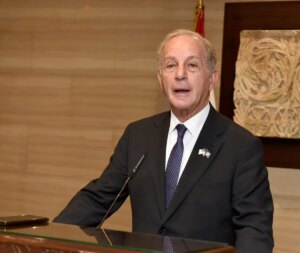
For his part, Morcos stressed that the press in Lebanon was never just a means of transmitting news, but rather formed part of the country’s history, memory, and national life, considering it an essential partner in building the state, monitoring its performance, and opening a space for public debate.
He said that Lebanon, which is based on diversity, needs a media that protects this diversity instead of turning it into a source of division, and a press that sheds light on the truth and confronts rumours, fake news and hate speech.
He stressed that regulating the media does not mean restricting its freedom, but rather fortifying it with professional and moral responsibility, in line with the constitution, laws, and major transformations that the sector is witnessing.
Morcos focused on the challenges of artificial intelligence, pointing out that it opens wide opportunities for the media, but in return it raises profound questions related to truth, credibility, human rights, and intellectual property.
He said: “Artificial intelligence may produce text, but it does not produce responsibility, and it may produce an image, but it does not have a conscience,” considering that the future of media is not based on man’s competition with the machine, but rather on his ability to use it without abandoning his mind, freedom, critical sense, and professional ethics.
At the conclusion of the celebration, Minassian presented Markos and the media with the St. Ignatius Maloyan Medal in their honor.