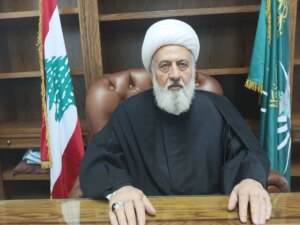
Speaker of the House of Representatives, Nabih Berri, did not name the President of the Republic, Joseph Aoun, nor did he direct a direct personal criticism at him, but in his speech on the anniversary of the disappearance of Imam Musa al-Sadr, he laid out a series of red lines that practically harm the negotiating path sponsored by Baabda, and strip it of the political cover it needs to continue.
When Berri says that the seriousness of the stage “does not give anyone the right to act on any of the sovereign titles, whether under the name of a framework agreement or secret annexes,” he is not objecting to a detail within the agreement, but rather challenging the method of its production and the limits of the authorization on which its owners relied. The message here does not need to be named: the party that led the negotiation and covered the agreement is primarily concerned with asking Berri about the right to dispose of sovereign issues.
From the perspective of the framework agreement, Berri does not reject the principle of negotiation as much as he rejects the formula according to which it is conducted: direct negotiation under fire, in the absence of a national consensus, while Israel continues its military operations, expanding its occupation, and changing the facts on the ground. Therefore, he did not discuss the terms of the agreement item by item, but rather tried to overthrow its political legitimacy from its foundations.
Berri specified, directly or implicitly, four prohibitions: refusal to turn the south into “experimental areas” in which the Lebanese army will be tested before Israel decides to withdraw, rejection of the security separation between the north and south of the Litani, refusal to replace the terms of reference of Resolution 1701 and UNIFIL with new bilateral arrangements, and refusal to suspend the right of Lebanon, institutions and individuals to pursue Israel and demand compensation for its crimes.
In this sense, Berri fears that the framework agreement will turn from a means to end the occupation into a mechanism that gives it a new cover, such that the Israeli withdrawal becomes conditional on Israel’s own assessment of the performance of the Lebanese army, and the “experimental areas” turn into a buffer zone from which the conditions for exit change whenever Lebanon implements a new condition.
When Berri asks: “Seven rounds of negotiation, what was the result?” Then he answers that the occupation has expanded, the areas of destruction have increased, and the number of martyrs has increased. He judges the agreement by its results, and directs a clear criticism of the management of the negotiating track. However, the link between the rounds and the expansion of the occupation remains more political than causal, because the coincidence of the negotiation with the continuation of the aggression does not necessarily mean that the negotiation was what caused the expansion of the occupation, but rather it may mean that Israel took advantage of it to improve its conditions by force.
On the other hand, Berri presents Resolution 1701, UNIFIL, and the Lebanese Army as the alternative reference for any bilateral arrangement. This is a strength of his speech, because he refuses to grant Israel the right to become a body that evaluates the army’s performance or determines its suitability to deploy on its territory. But he uses Resolution 1701 selectively, emphasizing what it imposes on Israel in terms of withdrawal and a cessation of violations, without addressing with the same clarity what it imposes on Lebanon in terms of the exclusivity of arms and security authority in the hands of the state.
This loophole also appears when Berri asserts that the South is the responsibility of the state and its military, security and constitutional institutions, without explaining how this responsibility can be established in light of the continued duality of arms and military decisions. The speech elevates the army to the position of national authority, but it does not provide a practical vision of how it can be able to perform this role alone.
Also, Berri’s statement that what is required of an Israeli is not Hezbollah or its weapons, but rather sedition, carries a clear degree of exaggeration. Israel is actually targeting the party and its weapons, but it is also using this targeting to impose a political and security restructuring of the south, and to transform the dispute over weapons from a Lebanese-Israeli conflict into an internal confrontation between the army and the southern environment. Here, Bree’s fears touch upon a real aspect of the danger, but they do not sum up the entire scene.
Legally, the absence of national consensus alone does not constitute sufficient reason to say that the negotiation is unconstitutional. Article 52 of the Constitution grants the President of the Republic the authority to negotiate treaties in agreement with the Prime Minister, provided that he informs the Council of Ministers, and that the obligations that require this pass through the competent constitutional institutions, including the House of Representatives, according to the nature of the agreement.
Therefore, the strongest objection is in Berri’s political and sovereign speech rather than a legal ruling invalidating the agreement. As for his talk about “secret annexes,” he raises serious doubts about transparency, but he needs to reveal the content of these annexes to prove that they created obligations that were not approved by constitutional institutions.
This escalation cannot be isolated from Berri’s position itself. Not only does he speak on behalf of the Amal Movement and the Development and Liberation Bloc, but he declares that any viable settlement requires a national cover that cannot be bypassed, and sends a message to Washington and Israel that understanding with the executive authority alone is not enough if an essential part of the Lebanese interior remains outside the agreement.
As for the message to Baabda, it is the clearest: The presidential margin in negotiations is not an open mandate, and any agreement that affects the territory, the form of security deployment, the right to sue, or the reference of Resolution 1701 will face political and institutional objection.
Thus, Berri did not announce a confrontation with Joseph Aoun, but he moved the dispute with him from behind the scenes to the public, and he corrected the choices of the era without correcting the president. It is a warning message to Baabda, and an attempt to impose a veto on the negotiating track before its understandings move from paper to the land of the south.