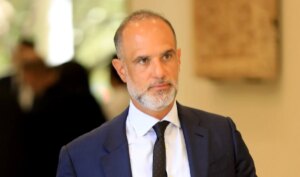
The political advisor to the head of the Free Patriotic Movement, Antoine Constantine, saw that the information circulating about an upcoming announcement of the birth of a new framework for resolving disputes with Iran, which includes Saudi Arabia, Egypt, Turkey, Pakistan, and perhaps Qatar, carries a positive aspect at the regional level, but in return it raises deep Lebanese concern.
Constantine wrote, through his account on the “X” platform: “Information about an announcement soon regarding the birth of a new framework for resolving disputes with Iran, which includes Saudi Arabia, Egypt, Turkey, Pakistan, and perhaps Qatar. It is a decision table that calls for optimism, but what is sad is that Lebanon is a subject for negotiation at the table, not a country sitting around it… When will the era of the failed state end?”
Constantine’s position comes at a very sensitive regional moment, with increasing talk about new understandings and negotiating paths between Washington and Tehran, and the involvement of major regional countries in trying to produce a broader truce formula that will be reflected in more than one arena, including Lebanon.
The importance of Constantine’s words lies in the fact that he puts the finger on a chronic Lebanese problem: Lebanon’s presence as a file on regional and international negotiating tables, versus the absence of the Lebanese state as a party with full capacity in decision-making or imposing its conditions. Whenever the pace of settlements in the region increases, the same question returns to the forefront: Will Lebanon be present with its decisions and institutions, or will it be reduced to an arena over which the interests of others intersect?
This reading is related to the current Lebanese reality, where the war in the south, the arms issue, the position on Iran, and American and Arab pressures intersect with the process of re-establishing the state’s role. In light of the talk about arrangements that include a ceasefire, withdrawal, borders, and arms control, there appears to be an urgent need for a unified official Lebanese position that prevents Lebanon from being turned into a side item in understandings that it does not actually participate in drafting.
The reference to Saudi Arabia, Egypt, Turkey, Pakistan, and Qatar reflects the expansion of the circle of influential parties in the approach to the relationship with Iran, after regional files became interconnected from the Gulf to Lebanon, Syria, Iraq, and Yemen. However, for Lebanon, this expansion may have two aspects: an opportunity to reduce escalation if the settlements succeed, and a danger if Lebanon remains a negotiating subject without an effective official presence.
Hence, Constantine raises the question of the “failed state” as a political summary of the stage, not just an internal description. The absence of the state from the decision-making table is not only linked to the weakness of institutions, but also to the multiplicity of decision-making centers within Lebanon, and the inability of the authority to impose its complete sovereignty over crucial files.
Thus, Constantine’s words turn into a call to restore the reputation of the Lebanese state as the only body authorized to negotiate on behalf of Lebanon and protect its interests, at a time when regional understandings are accelerating, and the danger of Lebanon’s future being drawn at tables at which it does not sit is increasing.