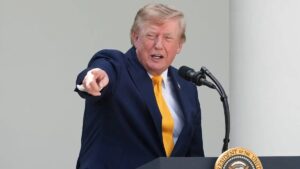
At a time when Damascus is experiencing unprecedented openness with Washington after the fall of Bashar al-Assad’s regime, an American report warned that the “golden opportunity” that Syria obtained with the administration of US President Donald Trump may be temporary, unless it moves quickly to transform this political rapprochement into permanent institutional relations within the United States.
According to a report by writer Amir Al-Samman entitled “The Syria Window in Washington will not remain open forever,” published by the American magazine National Interest, Trump’s decision to lift sanctions on Syria and normalize relations with Damascus created a rare state of consensus between Republicans and Democrats in Washington, as the decision received the support of leaders of both parties within the Senate Foreign Relations Committee, in addition to the support of ideologically contradictory political figures within the US Congress.
The report indicated that Syrian President Ahmed al-Sharaa, during his historic visit to the White House and his meeting with Trump, which was the first for a Syrian president to visit Washington since Syria’s independence in 1946, also met with the Chairman of the Senate Foreign Relations Committee, Jim Risch, and Democratic Senator Jeanne Shaheen, who considered that Syria was “turning into a partner of the United States” under the leadership of al-Sharaa.
The writer described the scene in front of the White House, where Syrian-Americans raised Syrian flags and cheered for Al-Sharaa’s procession, as reflecting a radical shift in the American view of Damascus, after the relationship moved from “deep suspicion” to “open friendship” within a short period.
However, the report warned that this rapprochement is not based on fixed institutions, but rather depends mainly on specific personalities, most notably Trump and the US special envoy Tom Barrack, who played a pivotal role in canceling the “Caesar Act” and in managing the relationship with Damascus during the post-Assad era.
The report pointed out that this reality raises concern within Damascus, especially since Trump will not remain in power indefinitely, while Senator Jeanne Shaheen will leave the Senate next January, in addition to the fact that American figures supportive of Syria are also facing internal crises, such as Republican Representative Corey Mills, who is under investigation by the Ethics Committee, and Representative Joe Wilson, who is suffering from health problems.
The writer emphasized that Syria has succeeded since December 2024 in amassing a large amount of “good will” within Washington, but it has not yet succeeded in building a relationship capable of withstanding after the departure of the figures who created this rapprochement.
He added that personal relations may be the beginning of any political openness, but they are not enough to ensure its continuation.
In a reading of the upcoming American political scene, the report warned that any Democratic administration that may reach the White House in 2029 may not deal with Syria with the same flexibility, especially since a number of Democrats show extreme positions towards the relations of the Gulf states with the Trump administration.
The report indicated that Damascus directly benefited from the support of Saudi Crown Prince Mohammed bin Salman and Qatari Emir Sheikh Tamim bin Hamad Al Thani in improving its relationship with Trump, at a time when prominent democratic voices are moving to attack what they describe as “geopolitical corruption” linked to the Trump administration’s relations with the Gulf.
The writer also pointed out that democrats usually focus on issues of democracy and political openness in their foreign relations, considering that the government of Ahmed Al-Sharaa has not yet given real priority to these files despite its success in improving living conditions and maintaining stability.
The report focused on the reality of the Syrian-American community, considering that it previously played a fundamental role in pressuring against the Assad regime and in supporting the repeal of the “Caesar Act,” but today it suffers from internal divisions and a power struggle between multiple organizations within Washington and Damascus.
The writer believed that this division weakens Syria’s ability to build permanent influence within the United States, especially with the movements of groups loyal to Iran or the former Syrian regime to pressure towards the re-imposition of sanctions on Damascus.
The report also criticized Damascus for appointing Muhammad Qantari as charge d’affaires in Washington, considering that his selection was based more on “political loyalty” than on diplomatic experience, despite the sensitivity of the stage and the relationship with the United States.
The writer explained that Washington is not a city that allows gradual learning within diplomatic work, but rather needs personalities who possess a wide network of relationships and deep experience within American institutions.
The report stressed that time is running out for Syria, with the US presidential elections approaching in 2028, and the possibility of launching electoral campaigns at the end of this year.
The writer concluded by stressing that Damascus has one last opportunity to consolidate its relationship with Washington by building bridges with members of Congress from both parties, encouraging American companies to invest in the reconstruction of Syria, in addition to appointing diplomats capable of building relationships across political administrations, because betting on people alone may not be enough to protect this rapprochement in the future.