The American-Iranian confrontation returned to direct military escalation in the Gulf waters, after the two sides exchanged strikes and accusations on Thursday in the vicinity of the Strait of Hormuz, in a development that effectively threatened the fragile ceasefire agreement that has been in place for about a month, and brought the region back to the brink of a wider explosion.
According to coverage by the New York Times, US Central Command announced that the US military carried out strikes against Iranian military sites in response to what it described as “unprovoked Iranian attacks” targeting US destroyers in the Strait of Hormuz.
Central Command said that Iranian missiles, drones, and small boats attacked 3 American destroyers as they were crossing the strait towards the Gulf of Oman, stressing that the American forces “eliminated the incoming threats” before targeting Iranian military sites linked to the launching of missiles and drones, in addition to command centers and reconnaissance and surveillance sites.
On the other hand, the Iranian army accused the United States of violating the ceasefire by targeting an Iranian oil tanker that was heading to the Strait of Hormuz, stressing that it “responded by attacking American military ships” in the region.
The report indicated that the explosions shook Qeshm Island and the city of Bandar Abbas, which are two of the most prominent shipping centers in the Strait of Hormuz, in addition to the capital, Tehran, according to Iranian media and testimonies of residents who published clips and information on social media sites.
The Iranian Armed Forces also announced that the United States and its “supporting countries” were behind the attacks, which came after an exchange of fire between American and Iranian ships near the Gulf.
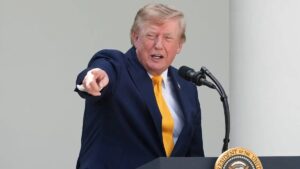
In his first comment, US President Donald Trump confirmed that the ceasefire “still exists” despite the military clash, noting that 3 “world-class” American destroyers were exposed to fire as they were leaving the strait, but they were not damaged.
Trump said that American forces “easily shot down” the Iranian missiles that were fired at American ships, while “the drones were burned in the air.”
“It fell very beautifully into the sea, just like a butterfly falling to its grave,” he added in his escalating style, describing Iran’s leaders as “crazy,” before threatening more strikes “if they do not sign the agreement quickly.”
At a time when the confrontations were escalating, the newspaper revealed that Washington and Tehran were discussing a one-page proposal to lift the American blockade on Iranian ships and ports, in exchange for Iran opening the Strait of Hormuz to commercial shipping traffic and ending the fighting for 30 days, to make way for negotiations on a comprehensive agreement.
However, the Iranian officials who spoke to the newspaper confirmed that the main node is still the Iranian uranium enrichment program and the stock of highly enriched uranium.
In parallel with the escalation, the report warned that the collapse of the ceasefire has become a realistic possibility, especially after the mutual attacks on ships and on the United Arab Emirates during the past days.
A spokesman for the Iranian Revolutionary Guard said on social media that “the United States violated the ceasefire.”
In a remarkable development, the report revealed that Trump was forced to back away from an American plan to escort commercial ships in the Strait of Hormuz, after Saudi Crown Prince Mohammed bin Salman refused to grant the United States the right to use Saudi airspace and bases to carry out the operation.
According to an American official and a person familiar with the Saudi position, the Saudi decision surprised the American administration and forced Trump to stop the operation less than 24 hours after it was announced.
The report indicated that Trump informed the Saudis that he had decided to “suspend” the operation due to “progress” in negotiations with Iran, despite the fact that there has been no actual breakthrough so far.
But behind the scenes, communications between Washington and Riyadh revealed the extent of the growing tension between Trump and Saudi Arabia, especially with Riyadh’s feeling that Trump’s policy towards Iran has become “volatile and unclear.”
The report pointed out that the Saudi Crown Prince was previously pushing for the continuation of US strikes against Iran to weaken the Iranian regime, but today he has become more inclined to end the war for fear of the regional situation falling apart.
In this context, the newspaper explained that Saudi Arabia fears that any additional escalation would lead to targeting its oil facilities and infrastructure, despite its success in reducing the dependence of its oil exports on the Strait of Hormuz via land pipelines.
It also indicated that the Saudi Foreign Minister is in frequent contact with his Iranian counterpart in an attempt to advance negotiations and end the confrontation.
In the midst of this tense scene, it seems that the region has entered a new phase of an open “war of nerves” between Washington and Tehran, where the question is no longer whether the confrontation will expand, but rather to what extent the two sides can continue to play on the brink of explosion without falling into an all-out war.