In a remarkable security development, the Syrian authorities announced the arrest of a German journalist and a Kurdish journalist during a security operation in the city of Raqqa, amid conflict in initial data about their identity and the nature of their presence inside Syrian territory, which opened the door to questions about the background of the mission and the circumstances surrounding their entry.
The Syrian government confirmed that German journalist Eva Maria Michelmann and Turkish Kurdish journalist Ahmed Boulad were arrested during a security operation carried out last January 18 in Raqqa, noting that investigations are still ongoing to uncover the circumstances of the case.
The Director of Press Affairs at the Syrian Ministry of Information, Omar Ibrahim, explained in a statement to the German News Agency that Michelman is currently detained by the Ministry of Interior under the supervision of the Internal Security Forces in Aleppo, while Boulad was arrested with her, pointing out that the authorities informed the German government of the incident.
According to data, the arrest occurred during a search of a building linked to a group linked to the “Syrian Democratic Forces,” where everyone inside was arrested after fighters barricaded themselves in the place. Later, two foreign nationals were identified among those arrested.
During the investigations, the authorities reported that Michelman initially presented herself as a Spanish citizen and working for a United Nations organization, but a review by the UN authorities denied the presence of any missing employees in the region, before it later became clear that she was a German journalist without being able to present documents proving her mission.
The Ministry also indicated that Michelman and Boulad attempted to escape during the initial investigations, which was documented by surveillance cameras, which prompted them to be dealt with on suspicion of illegal presence within areas under state control, and to be considered “foreign fighters” until legal procedures are completed.
The authorities confirmed that investigations are still ongoing in preparation for referring them to the competent judiciary, at a time when Damascus asked Berlin to provide it with additional information about the journalist’s identity and background.
On the other hand, the Michelman family, from the city of Cologne, reported that she was working as a freelance journalist inside Syria, while the German Foreign Ministry announced that it was making “intensive” efforts to release her, after she was classified as missing before her detention was confirmed.
At the end of April, a representative of the German embassy in Damascus visited the detained journalist, in the first official contact with her since her arrest, indicating that the file had entered an open diplomatic track between the two countries.
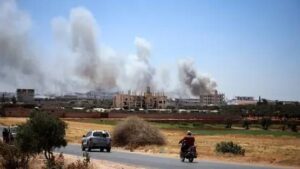
This development comes in the context of a complex security environment in northern and eastern Syria, where control overlaps between several local and international parties, making the movement of journalists and foreign workers risky, especially in areas close to the lines of contact or those witnessing intermittent military operations.
These areas witness the presence of multiple forces, including the Syrian army and the “Syrian Democratic Forces,” in addition to other groups, which imposes strict restrictions on entry and movement, and makes any uncoordinated foreign presence vulnerable to arrest or legal prosecution.
This incident also brings back to the forefront the issue of the safety of journalists in conflict areas, where media professionals face major challenges ranging from direct security risks to the difficulty of obtaining official permits, in addition to being sometimes suspected of being parties involved in the conflict, especially in the absence of prior coordination with official authorities.
In this context, questions are raised about the mechanisms of independent journalism in conflict zones, and the limits of protection that international laws can provide, versus considerations of national sovereignty and the security measures adopted by states in dealing with foreigners within their territories.