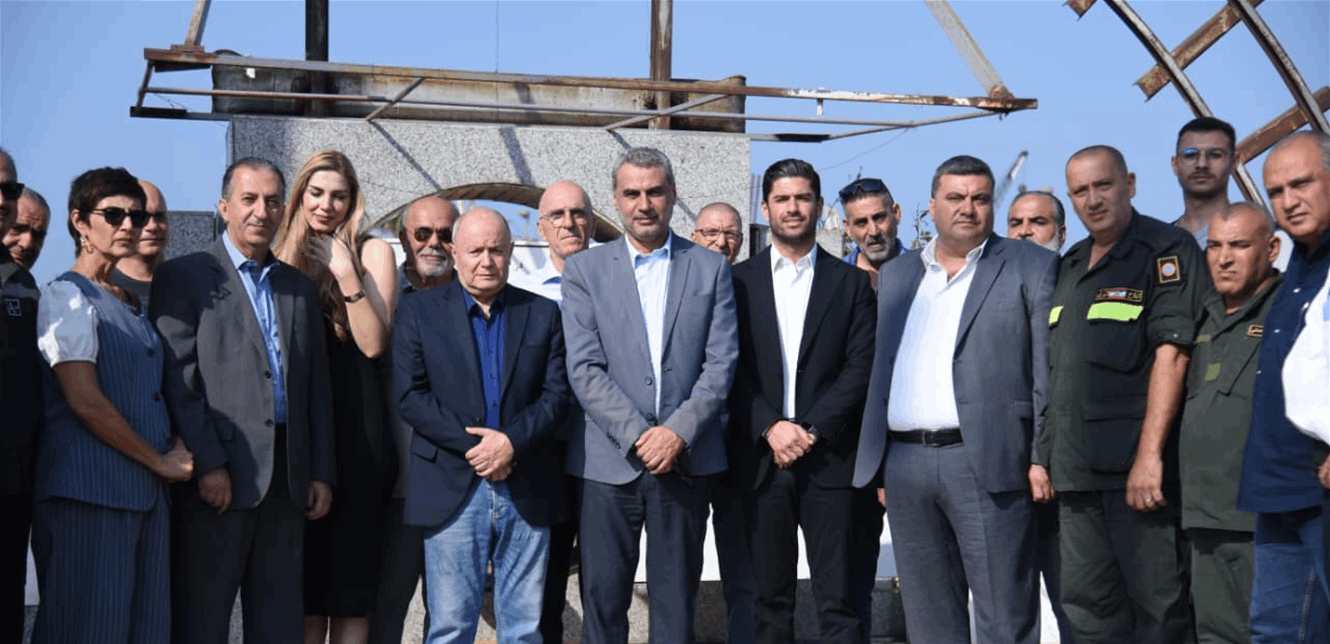
The tour began from the train station in Chekka, where Shia was briefed on the status of the property on the ground. He then moved to the main center of Al-Ahdab Company, the private company operating public transport in Lebanon, where he was received by Mr. Aouni Al-Ahdab, the company’s Executive Director.
Shia toured the company’s operations room and listened to a detailed explanation from the team about the advanced technologies used in the operations room and the mechanism for directly monitoring the movement of buses. He also reviewed the control, safety, and comfort devices provided by the company for passengers on public transport buses.
After that, Shia, Al-Ahdab, and the accompanying delegation moved to the train station center in the city of Mina, where they were received by the Regional Head of Civil Defense, Wassef Karima. They then toured the station, during which the Director-General Shia was briefed by Al-Ahdab on the places where transport buses stop, and they also visited the Al-Sabaa Tower in Mina.
During the tour, Shia stated: “The Tripoli train station means a lot to us historically and as a glimpse into the future. Everyone wishes for the return of the beautiful past, and we insist that the beauty extends to the present and future. What we are doing first in the public transport sector is a continuous and ongoing development process so that we can reach a place where we can provide a service to the Lebanese citizen who deserves all the best.”
He added: “At the train level, everyone knows that we are striving to preserve the railway properties and clean them up to benefit from them at the time when the government makes the decision to re-launch this route in Lebanon, as the train remains a primary means of transportation in all countries of the world, regardless of their level of development.”
He continued: “We came today to visit this historic place in the presence of Professor Aouni Al-Ahdab, who is the best at working within the framework of partnership with the public sector. This model experience should be generalized to many sectors at the level of partnership with the private sector, and we are waiting for more buses to enhance public transport further. It is necessary to emphasize the importance of cooperation and coordination between all sectors and those concerned with public transport in the country because it is a national responsibility, and it is not permissible to deal with the public transport sector in the country separately.”
Shia concluded by directing “greetings to the members of the Civil Defense who provide their services with very limited capabilities and from their own resources for the sake of the citizen and the country.”
Al-Asmar, in turn, said: “I extend my greetings to the Director-General of Railways for this renaissance that we see in the sector he represents, which is a renaissance that we have missed for a long time. What we aspire to today is to put the sound thinking represented by the Director-General in the executive framework in terms of what is being said about the arrival of buses and putting them in the foreseeable future at the disposal of the people within the partnership between the public and private sectors. This partnership may be the salvation for launching projects. We must also not forget what Professor Shia is planning within the BOT and what is being studied within the railway transport that extends from the north to the south and the necessity of launching it at this stage because of what it represents in providing exorbitant transportation costs to the working class.”
He added: “I want to extend my greetings to Professor Shia for the tour he made in Dahr al-Baidar and the Bekaa, which also laid the foundation for the major project, which is connecting Beirut to the Bekaa with modern roads, which reduces the economic burden on the citizen, whether in the public or private sector.”
Al-Ahdab, for his part, expressed his welcome to the Director-General, the President of the Union, and all those present in their city of Tripoli, stressing that the great efforts and diligent follow-up made by the Railway Authority, represented by the Director-General, have led to the success of this model partnership between the public and private sectors. He hoped that everyone would continue with this activity, noting that they have exceeded 7,000 passengers per day thanks to this follow-up, expressing his hope for continued support in this area in terms of increasing buses and opening new lines so that they can all provide more assistance in serving their country.
Al-Sayed, in turn, affirmed that what is happening in the issue of public transport is very important, and that they have seen great interest from the Railway Authority and Al-Ahdab Company, the operator of public transport, in terms of safety, control, follow-up, and organization, expressing their thanks for this good work and wishing the state, which has begun to organize all sectors, to work on organizing the land transport sector, which suffers from the chaos of forgery, duplication, and so on.
In conclusion, Al-Ahdab hosted a luncheon in honor of the Director-General and the accompanying delegation, in the presence of former MP Misbah Al-Ahdab, the head of the Al-Fayhaa Municipalities Union, Wael Zumarli, the Mayor of Tripoli, Abdulhamid Karima, the Mayor of Mina, Abdullah Kabbara, and Brigadier General Fadi Al-Ruzz.