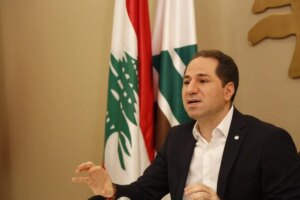
Representative Hassan Murad pointed out during the graduation ceremony for students at the Lebanese International University in Tripoli that “the north does not suffer from a lack of competencies or will, but rather from a lack of opportunities,” pointing out that “balanced development is a condition for the unity of the state, and that the development of Tripoli and Akkar “is not a privilege for the north, but rather an application of the principle of justice and equality in the Lebanese Republic.”
Murad called for “moving from welfare to development and transforming the north into a productive economic center by creating real opportunities and investing in the components of Tripoli and Akkar, so that the state reaches the citizen instead of the citizen being forced to search for the state outside his region.”
Murad stressed the necessity of “adhering to the Taif Agreement and implementing it fully,” stressing that Taif is not just a settlement that ended the war, but rather a project to build a modern state based on balanced development, institutions, decentralization, and a state of citizenship.
He called for the implementation of expanded administrative decentralization as stipulated by Taif, considering that it does not mean dividing Lebanon, but rather strengthening the state, improving its administration, and achieving development and balanced development, while preserving Lebanon “unified in land, people, and institutions.”
Murad believed that building a state that relies on efficiency, not mediocrity, an independent judiciary, and an impartial administration that holds the corrupt accountable, regardless of his position, requires protecting the rights of depositors and public money, fixing the financial crisis, and ending quotas.
He also explained that serious treatment of the financial crisis begins with defining responsibilities, distributing losses fairly, and protecting citizens from the cost of mistakes they did not commit.
Murad affirmed Lebanon’s right to protect its land and sovereignty, calling for confronting the occupation and attacks by political, diplomatic and legal means, in parallel with the state assuming its responsibilities towards the affected citizens and not abandoning its members of force and working to release its prisoners.
He said: “At the same time, we must realize that Lebanon’s security cannot be separated from the security of its surroundings. Arab security is one and indivisible, and Lebanon’s security is part of Syria’s security, just as Syria’s security is part of Lebanon’s security, while the stability of any Arab country constitutes a pillar of the strength and stability of all other Arab countries.”
He added: “The aggression and violation of its sovereignty that befalls Syria cannot be viewed as an issue far away from us, just as what befalls Lebanon, Palestine, or any Arab country should not be an issue for its people alone.”
Murad drew a clear equation for Arabism, that the strength of any Arab country should be a strength for its brothers, not a source of fear for them. From this standpoint, he called on the United States for real stability not governed by double standards.
He pointed out that “a just peace is the basis of stability,” reiterating that the reconstruction of the south and the Bekaa is a “national responsibility,” and the development of Akkar and Tripoli is a “comprehensive national issue.”
Murad placed youth migration at the forefront of the challenges facing Lebanon, linking confronting this phenomenon to building a productive economy and investing in technology and people, pointing out that the people of the North are “Lebanon’s deferred wealth.”
He considered that Lebanon’s crises “are not final destiny,” noting the importance of “not waiting for change, but rather contributing to making it,” stressing that Lebanon does not rise from its center alone. Lebanon rises when all its regions rise.