“Lebanon Debate” – Brigadier General Mounir Shehadeh
How did the Pakistani army chief rise to the pinnacle of power? Why did he become the most influential player in Pakistan and a mediator between Trump and Tehran?
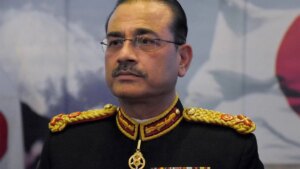
In Pakistan, it is not enough to read the political scene through the President of the Republic or the Prime Minister. Since the founding of the state in 1947, the army has remained the most influential institution in determining the direction of security and foreign policy, even when rule remained nominally in the hands of civilian governments. In 2026, this reality became clearer with the rise of Field Marshal Syed Asim Munir to a position that combines the leadership of the army and the leadership of the Pakistani armed forces, which made him one of the most prominent men in the region and the most closely linked to the American, Iranian, Saudi and Turkish files.
Perhaps the greatest irony is that the man who has today become a channel of communication between Washington and Tehran was not, in his early days, a natural candidate to be an international diplomatic player. He began his military career at the Officers Training School in Mangla, and graduated in 1986 from the Frontier Force Regiment, winning the Sword of Honor as the best officer in his class, before moving through a series of operational and intelligence positions that later made him one of the most experienced officers in the Pakistani military establishment.
From a field officer to the head of intelligence
The importance of Mounir’s career lies not only in his rise to the rank of general, but also in the fact that he combined rare experiences within the military institution.
He served in the northern regions bordering India and China, and also served in Saudi Arabia, then took over the leadership of Military Intelligence (MI) in 2017, before becoming in 2018 Director General of Pakistani Intelligence (ISI), which is the most powerful intelligence service in the country and the most influential in security and foreign policy files. He was the first Pakistani army commander to combine the leadership of MI and ISI in his career.
But the irony of his career is that his presence at the head of ISI did not last long. He was dismissed about eight months later at the request of then Prime Minister Imran Khan, in a move whose reasons were not officially announced. His relationship with Imran Khan remained one of the most sensitive political issues in his subsequent career.
After that, he assumed command of the Gujranwala Corps and then the position of Supply Commander in the Army Command, before reaching the top of the military establishment in November 2022.
How did he reach the leadership of the army?
When Prime Minister Shahbaz Sharif chose Asim Munir as army chief in November 2022, the choice was not simply to appoint a new military chief. The army was at the center of an intense political conflict with Imran Khan, and the military establishment was aware that the identity of its next leader would have a direct impact on the country’s political future.
Munir assumed command on November 29, 2022, succeeding General Qamar Javed Bajwa, at a time when Pakistan was facing a deep economic, security and political crisis. Munir was one of the most senior officers and had extensive intelligence and operational experience.
But Mounir’s real rise began after that.
The short war with India in 2025 marked a major turning point in his career. After the confrontation, he was promoted to the rank of Field Marshal, becoming the second person in the history of Pakistan to obtain this rank after Ayub Khan. Then the most important step came in December 2025, when he was appointed the first Chief of Defense Forces while continuing as Army Commander for a period of five years.
Here he moved from being a mere army commander to the actual command center of the entire military institution.
Why is he considered the most powerful man in Pakistan?
To understand Munir’s power, one must understand the nature of the Pakistani regime itself.
Pakistan is a nuclear state, and the army is not just a conventional defense institution. It is a major player in national security and relations with India, Afghanistan, China, the United States, and the Gulf states, and its domestic influence extends to politics, economics, and security.
Therefore, combining the position of army commander with the position of commander of the defense forces puts Munir in an exceptional position: he leads the army, enjoys great influence over the military and security institutions, and plays a pivotal role in foreign policy and national security files.
That is why Western analyzes described him as becoming the most powerful man in the country. Some analyzes even considered that civilian influence in Islamabad cannot be understood without reading the position of the army leadership.
Can he be described as the “de facto ruler” of Pakistan?
This matter requires some precision, as Pakistan still has a president, a government, a parliament, and constitutional institutions. However, the balance of power between civilian and military makes the army commander an exceptional influence on strategic decisions.
From Washington to Tehran
Here lies Asim Mounir’s current importance.
The man did not become a mediator between the United States and Iran by chance. In recent years, he has been able to build a strong personal and political relationship with US President Donald Trump.
In 2025, after the Indian-Pakistani confrontation, Trump received Munir at the White House in an unusual meeting, and then the relationship between the two men developed remarkably. Western reports indicate that Islamabad has made extensive efforts to improve the relationship with Washington, while Munir succeeded in presenting himself to the US administration as a partner capable of achieving results in sensitive security and regional files.
Most importantly, this relationship did not remain personal.
Washington views Pakistan as a country that possesses what many countries in the region do not have: great military power, nuclear weapons, borders with Iran and Afghanistan, a historical relationship with China, strategic relations with Saudi Arabia and Turkey, and open channels with Tehran.
This makes Mounir, for Washington, more than a military commander.
It is a strategic communication channel.
Why did Trump choose Mounir specifically?
The current landscape clearly provides the answer.
On August 24, 2026, Pakistani sources revealed to Reuters that Trump spoke by phone with Munir before heading to Tehran, and that the US President asked him to use Pakistan’s influence to persuade Iran to return to negotiations. Most importantly, the call, according to the sources, came at the initiative of Trump himself.
This is not a passing diplomatic detail.
When the US President contacts the commander of the army of a third country and asks him to intervene with Iran, this means that Washington sees this man as a more effective channel than traditional diplomatic channels.
And why?
Because Mounir can speak with Washington in the language of security and strategy, and at the same time he can communicate with Tehran from the position of a neighboring Islamic country with which Iran has historical, geographic, and economic relations.
Thus, Pakistan does not present itself as a completely neutral mediator, but rather as a country that can talk to both parties at the same time.
Tehran also needs this channel
The irony is that Mounir’s importance to Washington does not mean that he has become Washington’s man in Tehran.
The opposite is true.
Iran has an interest in using the Pakistani channel because it needs a channel that can transmit messages to the American administration without going directly through European or Gulf mediators.
Here the importance of Mounir’s visit to Tehran in August 2026 appears.
He headed to the Iranian capital at the head of a high-ranking delegation, and met with the Iranian leadership, while Pakistan announced that the talks dealt with stopping the escalation, reopening the Strait of Hormuz, ending the war, and searching for a negotiated settlement. On August 24, the Pakistani Interior Minister spoke of “important progress” in the talks.
Thus, Mounir is faced with a very complex equation:
Washington is confident that he can influence Tehran, and Tehran agrees to listen to him because he comes from Pakistan, not from the United States.
This is the value of the broker.
The American relationship is not the result of the Iran war.
It is a mistake to think that Mounir’s relationship with Trump began with the current US-Iranian negotiations.
I started before that.
After the India-Pakistan confrontation in 2025, Washington played a role in stopping the escalation, and Islamabad emerged from the crisis considering Trump an important factor in preventing the conflict from escalating.
Then came a series of contacts and meetings between the Pakistani leadership and the American administration, leading to Munir’s meeting with Trump in the White House.
Reports indicate that Pakistan has also sought to strengthen its economic relations with the United States, at a time when Islamabad is trying to reduce its financial dependence on China and open up again to American institutions and markets.
But Washington does not view Mounir only as an economist.
She sees him as a security man capable of carrying out what he undertakes.
This type of partnership is what US administrations prefer in sensitive files.
Mounir between America and China
Here we must not make another mistake: Munir’s relationship with Trump does not mean that Pakistan has joined the American camp against China.
China remains Pakistan’s most important strategic partner in many areas, and is also one of its largest creditors.
But Islamabad is today trying to restore balance to its foreign relations.
Instead of making a complete choice between Washington and Beijing, Pakistan wants to benefit from both sides.
This also explains the importance of Munir’s personality: he can talk to Washington, while at the same time maintaining Pakistani channels with Beijing, Tehran, Riyadh, and Ankara.
It is moving within a policy that can be called multi-axial.
Why did Pakistan become a player in the Iranian file?
Because geography gave her what money couldn’t buy.
Pakistan shares a long land border with Iran (909 km), and has direct interests in the stability of Balochistan, the Strait of Hormuz, and the security of the Gulf.
On the other hand, it has deep strategic relations with Saudi Arabia and Turkey, two countries that have become part of new regional security arrangements with Islamabad.
Pakistan is also a nuclear state and its army is one of the largest in the world.
Therefore, its entry into the US-Iranian crisis is not merely diplomatic mediation, but rather carries behind it real military and strategic weight.
The man who went from a military leader to an international player
Asim Mounir’s journey can be shortened to four stops:
Intelligence officer, army commander, field marshal and commander of the defense forces, mediator between Washington and Tehran.
But the most important thing is that each station built the next.
His experience in intelligence gave him the ability to understand secret files.
His leadership of the army gave him internal political power.
His promotion to the rank of Field Marshal and assumption of command of the Defense Forces gave him exceptional military authority.
His relationship with Trump gave him a direct window into the White House.
As for his regional relations, from Saudi Arabia to Iran and Turkey, they gave him something that a traditional diplomat cannot easily possess: the ability to open contradictory doors at the same time.
Has Munir become America’s man in the region?
It is more accurate to say that Washington sees in him a reliable partner, and not necessarily its subordinate.
This is a fundamental difference.
Munir moves to pursue Pakistan’s interests first. Islamabad wants to avoid a new regional war, protect its economy, ensure the flow of energy, expand its relations with Washington, and at the same time maintain its relationship with China, Iran, Saudi Arabia, and Turkey.
As for the United States, this move sees an opportunity to use Pakistan’s influence to pressure negotiations with Iran without Washington being forced to make direct concessions from the beginning.
That is why Asem Munir has today become one of the most important unofficial mediators in the US-Iranian crisis.
Why Asim Mounir now?
Because the region has entered a stage in which traditional diplomacy alone is no longer sufficient.
There is war, sanctions, the Strait of Hormuz, Iranian regional influence, new Gulf alliances, US-Chinese competition, and the risk of the conflict expanding.
In the middle of this scene stands Pakistan, a Muslim nuclear state, with a strong army and relations with almost all parties.
At the forefront of this role stands Asim Mounir.
He is not the president of Pakistan, but he has the tools of power that make his voice heard in Washington, Tehran, Riyadh, Ankara, and Beijing.
Therefore, the last phone call between him and Trump before his travel to Tehran is not just a call between an American president and a foreign army commander.
It is an indication of the birth of a new Pakistani role in the Middle East, and that Asim Munir is no longer acting merely as the commander of the Pakistani army, but rather as one of the players trying to shape the features of the new regional order.
The question that will determine the next stage is not whether Mounir is able to mediate between Washington and Tehran, as he has already proven that he has this ability.
The real question is:
Can Pakistan, through Asim Munir, transform from a temporary mediator in the Iran war into a permanent strategic player in the Middle East equation?
The answer may be more important than the outcome of any single negotiating round, because Islamabad’s success in this mission will give it international weight that far exceeds the size of its economy, and will make its army commander one of the most influential men in the region in the coming years.