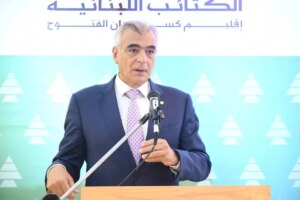
In a political stance that carried escalatory messages regarding the course of the negotiations and the reality on the ground, Khalil Hamdan, a member of the Presidency of the Amal Movement, considered that the continued Israeli procrastination and its failure to adhere to international resolutions must prompt a halt to the direct negotiations and their artistic and technical outcomes, stressing that what Lebanon is exposed to is not merely border incidents, but rather part of a broader plan targeting Lebanon and the region.
Hamdan’s words came during a celebration held in the southern town of Ankoun, on the occasion of the week of Ahmed Farhat, brother of the martyr Ibrahim Farhat, who was a companion of the two martyrs, the brothers Zuhair Shehadeh and Muhammad Al-Dirani, in more than one location and confrontation.
A number of religious scholars, mayors, elective bodies, and club presidents participated in the celebration, in addition to the labor official for the southern region, Ajmal Jouni, and the seventh region official, Rami Hamdan, in addition to officials from the “Amal” movement and “Hezbollah.”
Hamdan said, “Experimental areas do not exist in the enemy’s behavior, which indicates dangers targeting the land and people,” considering that “the procrastination practiced by the Israeli enemy should constitute a reason for not continuing the direct negotiations and their artistic and technical outcomes.”
At the beginning of his speech, he stopped at the history of the town of Ankoun, considering it “a pioneering town in martyrdom and giving,” and said that it “provided more martyrs to preserve the nation and preserve the people of the nation.”
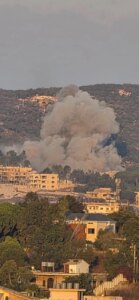
He added that the conflict with Israel “is not new,” noting that Lebanon has been subjected to Israeli attacks since 1948, and said that “the caravan of martyrs bears witness to that.” He considered that what is happening today “is not a border incident,” but rather “an American-Israeli plan targeting Lebanon and the region in light of the new world order.”
He wondered: “Are American aircraft carriers and destroyers traveling 16,000 kilometers for a border incident? Is the destruction of villages, bulldozing lands, and targeting children just a reaction, or is it a deliberate plan?”
Hamdan recalled the positions of Imam Sayyid Musa al-Sadr, referring to his warning against the “Israeli era,” stressing in return adherence to the principles of national unity and the promotion of civil peace, an approach that he said Parliament Speaker Nabih Berri is constantly keen on.
He stressed that the advancement of the state and its institutions cannot be achieved by disrupting the sessions of the House of Representatives or obstructing draft laws and proposals, considering that the ruling in the end “remains with the citizen to determine who wants to advance the country and who obstructs the work of state institutions by exceeding the quorum in the sessions.”
Hamdan concluded by emphasizing that “Israel has not adhered to international resolutions,” considering that the violations that Gaza witnesses daily, despite international conferences and political efforts, are clear evidence of the continuation of this approach, asking: “So who does?”
Hamdan’s position comes in light of the continuing tension on the southern front, in conjunction with diplomatic efforts led by the United States and a number of countries to reduce the escalation and stabilize the cessation of hostilities agreement. On the other hand, Lebanese accusations against Israel of not fully adhering to its pledges continue, especially with regard to stopping attacks and withdrawing from the Lebanese territories it still occupies, while the Lebanese authorities affirm that any negotiating path must start from respect for Lebanese sovereignty and implementation of international resolutions, most notably Resolution 1701.
These positions also coincide with the continued internal division over the future of any direct negotiations with Israel, between forces that consider that the priority is to ensure a cessation of attacks and the implementation of international obligations, and others that reject in principle any direct negotiating path before ending all causes of the conflict, considering that the continuation of Israeli military operations makes any negotiations lose their political and security feasibility.