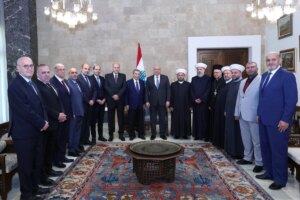
The Minister of Interior and Municipalities, Ahmed Al-Hajjar, received, in his office at the Ministry, a delegation of Beirut MPs that included Fouad Makhzoumi, Ghassan Hasbani, Paula Yacoubian, Nadim Gemayel, Faisal Al-Sayegh, Hagop Terzian, Amin Sheri, Adnan Trabelsi, Edkar Trabelsi, Nicolas Sehnaoui, and Muhammad Khawaja, in the presence of the Governor of Beirut, Judge Marwan Abboud, and the President of the Municipal Council, Ibrahim Zidane.
During the meeting, they discussed the administrative and financial affairs of the capital, and ways to enhance the support provided by the Ministry of Interior and Municipalities to the governor and the municipal council, in order to ensure the proper functioning of the public facility and improve the service reality in Beirut.
The attendees also discussed the security situation in the capital, and the measures taken to regulate traffic, reduce congestion, and suppress violations, in addition to strengthening coordination between the Internal Security Forces and the Beirut City Guard Regiment, which contributes to maintaining security and stability within the city.
Minister Hajjar stressed that Beirut, with its national symbolism and unifying role for all Lebanese, receives special follow-up by the Ministry, stressing the keenness to dedicate the principles of transparency, accountability and anti-corruption in various departments and institutions, in a way that enhances citizens’ confidence in the state.
This meeting comes in light of the accumulated challenges facing the capital, from service and municipal files to the traffic crisis and pressure on infrastructure, through administrative organization files and oversight of violations, which are issues that have begun to affect the daily lives of Beirutis and require direct coordination between the ministry, the governorate, the municipal council, and the representatives concerned with city affairs.
Beirut gains special importance in any official follow-up, as it is the political, administrative and economic capital of Lebanon, and an essential center for public and private institutions, which makes improving its administration, services and security a national priority that is not limited to its residents alone, but is reflected in the image of the state and its ability to manage public facilities at a stage in which institutions need to regain the confidence of citizens.
The focus on transparency, accountability, and combating corruption in the work of municipal departments and institutions constitutes an essential input for any actual reform in the capital, especially since improving services is not only linked to securing funding and support, but also to good management, activating oversight, and ensuring the use of resources to serve the public interest.
In this context, coordination between the Internal Security Forces and the Beirut City Guard Regiment constitutes an essential element in dealing with security and traffic files, especially with regard to regulating traffic, reducing violations, protecting public facilities, and keeping up with the capital’s daily needs, in a way that enhances the state’s presence in the streets of Beirut and its institutions.