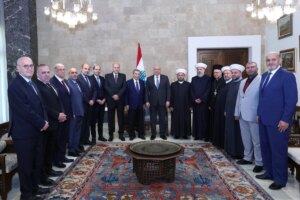
The President of the Republic, Joseph Aoun, adhered to the choice of the state and its institutions as the primary gateway to protecting Lebanon and its stability, stressing that the unity of the Lebanese constitutes the strongest weapon in the face of internal and external challenges, while calling for giving the negotiating path a chance before judging its results, stressing that the goal remains to stop the Israeli attacks and restore complete stability in the south.
Aoun’s positions came during his meeting with Sheikh Akl of the Druze Unitarian sect, Sheikh Sami Abi Al-Munna, and representatives of the leaders of the sects participating in the spiritual summit, where he affirmed his full adoption of what was issued by it, considering that experiences have proven that “it is not possible to live outside the framework of the state, and otherwise constitutes a sin.”
President Aoun stressed that Lebanon’s strength does not lie in traditional weapons, but rather in its national unity, noting that the spiritual summit meeting came in response to all attempts aimed at suggesting the existence of a religious or sectarian conflict in Lebanon, stressing that these proposals do not reflect the reality of the Lebanese reality and will not find their way to implementation.
He stressed that Lebanon cannot continue without the integration of its national components, Christian and Islamic, calling for a stand against sectarian and denominational discourses, and considering that the right to difference is legitimate and sacred, provided that it remains within the limits of morality and respect for others.
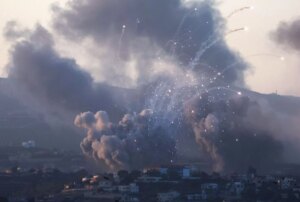
Regarding the southern file, Aoun stressed that any attack on any Lebanese region is an attack on all of Lebanon, stressing that what the state is doing is based on clear goals: stopping Israeli attacks, Israel’s withdrawal from Lebanese territory, the return of the displaced and prisoners, and the deployment of the Lebanese army in the south and assuming responsibility for security, in addition to launching the reconstruction workshop.
In defending the negotiating path, Aoun said that the war experience did not achieve the desired goals, but rather left nearly 4,000 martyrs and billions of dollars in material losses. He wondered why he refused to give the negotiations an opportunity to see what they could achieve before issuing prejudgments and accusing those in charge of negligence or surrender.
He also denied the existence of any disagreement with Speaker of Parliament Nabih Berri or Prime Minister Nawaf Salam, stressing that there is complete consensus on the basic national goals, and that any difference in viewpoints remains a natural and healthy matter within institutional work, in light of continued communication and coordination for the benefit of the country.
The President of the Republic stressed the importance of the state restoring its full role and strengthening its security, judicial and economic institutions, while preserving national unity, which constitutes the basic guarantee for confronting the challenges and ambitions of Israel.
In a separate context, Aoun received the regional president of the Carmelite Order and members of the Advisory Council, noting the spiritual and national role that the order has played since its presence in Lebanon in 1643, and stressing the importance of its educational mission and support for schools, considering that science constitutes the true wealth of Lebanon and the basis for building nations.
He also received a delegation of representatives of Lebanese technology companies, where he stressed that hope in Lebanon will remain as long as there are Lebanese people capable of creativity and innovation despite all the difficulties and challenges, stressing the importance of investing in human energies and young talents as one of the most prominent elements of economic advancement in the next stage.
The positions of the President of the Republic come at a delicate stage that Lebanon is going through, in light of the continuing security tension on the southern borders, and the increasing bets on the negotiating path aimed at consolidating the cessation of Israeli attacks and restoring stability to the border areas. It also coincides with the escalation of internal debate about the future of the state, its role, and mechanisms for strengthening its institutions in the face of political, economic, and security challenges.
Since President Joseph Aoun assumed his duties, the new era has been trying to push for the restoration of official institutions and strengthening the state’s presence in various files, in parallel with diplomatic and security efforts to distance Lebanon from the dangers of sliding into new confrontations, amid repeated emphasis that national unity remains the basic foundation for protecting the country at this sensitive stage.