Muhammad Al-Junun
The Iranian strike that recently targeted Israel in response to the targeting of the southern suburbs of Beirut generated many scenarios that cannot be overlooked, especially with regard to Hezbollah and its pressure on the context of the negotiations that Lebanon is conducting with Israel under American auspices.
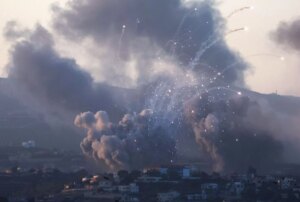
Between Sunday and Monday, Hezbollah received a dose of support from Iran after its response to the bombing of the suburb, while Tehran spoke about the possibility of new attacks if Israel targeted Lebanon. The question is: Which Lebanon do you mean by Iran? The south is being bombed, and the raids on it are continuing and have not stopped.
Sources concerned with military affairs told Lebanon 24 that Iran tried to separate southern Lebanon from the suburb, noting that there are clear indications that there is a green light to complete all Israeli military operations in the south without any deterrent.
In practice, what Israel is doing in the south comes with American cover, while Iran’s talk exclusively about the suburb means that the southern card is not included in the threats it is making, thus establishing an equation stating that the south is not included in Iran’s calculations, and that the matter is related to Hezbollah’s “strategic stronghold,” meaning the suburb.
At the same time, an additional question arises: What if Israel targets Hezbollah figures outside the suburb? Will Iran respond to this, or are its responses linked to a specific “geographical spot”?
These questions are legitimate and are being asked, but the different contexts reveal that Iran is currently using the Lebanon card for two reasons: the first is to float itself among the Shiite community as the “most prominent defender,” and the second is to establish the Lebanon card within the negotiating file with America, because the proximity of Lebanon’s borders to Israel makes this country influential for Iran, in addition to the fact that the presence of “Hezbollah” in it has direct repercussions on Israel and, subsequently, America.
At the same time, there is also a third reason that cannot be overlooked, and it is related to Iran’s attempt to send a political message to Hezbollah’s supporters that Iran is defending them, not the Lebanese state.
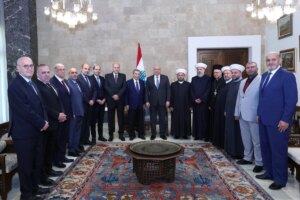
In practice, the Iranian attack was preceded by a condemning campaign launched by an Iranian media outlet against the President of the Republic, Joseph Aoun, which indicates the existence of a clear political goal on Iran’s part, based on targeting the state, not to mention the arrows directed by Iranian Foreign Minister Abbas Araqchi towards the President of the Republic, Joseph Aoun, when he told him: “If Lebanon were a bargaining chip for Iran, we would have reached an agreement a long time ago. Save Lebanon from your real enemy, Mr. President.”
In fact, and in the face of all of this, the Iranian trend in Lebanon emerges from field areas that have imposed themselves, and the question is: What are the limits of Iranian verbal escalation? Will Tehran risk an agreement with America for the sake of Lebanon?