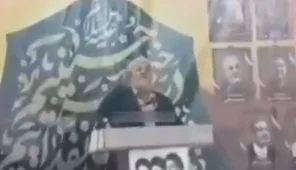
In the first official Iranian acknowledgment of the seriousness of the injury of Iranian Leader Mojtaba Khamenei, member of the Council of “Leadership Experts” Ahmed Khatami revealed that Khamenei was injured in the leg during the first day of the American-Israeli war on Iran.
Khatami confirmed, during his meeting with members of the Administrative Council of the city of Sirjan, that the seriousness of the injury prompted doctors to consider the possibility of amputating the leg before they could save it medically, according to what was reported by Iranian media.
This statement is the first official confirmation from within Iran regarding the nature of the injury suffered by Khamenei, coinciding with his complete absence from public appearance since his election last March to succeed his father, Ali Khamenei, who was assassinated on the first day of the US-Israeli war on Iran on February 28.
This continued absence raised questions about his health condition and the extent of his hold on power, despite increasing indications of his involvement in managing governance and decision-making.
In this context, Farzan Thabet, an expert on Iranian affairs at the Geneva Institute for Graduate Studies, believed that Mojtaba Khamenei is playing, most likely with the help of his office, a role in supervising the general direction of policies, including the main positions in the negotiations with the United States, considering that the level of his personal involvement is still lower than the level of his father’s influence, but it is likely to expand as his health situation improves and security conditions stabilize.
For his part, University of Ottawa professor Thomas Juneau considered that Khamenei’s role is still unclear, suggesting that he does not currently enjoy the same influence that his father did, but he pointed to his close relationships with influential figures, especially within the Revolutionary Guard.
Gono added that power currently appears to be in the hands of an “informal committee” that includes commanders in the Revolutionary Guard and a number of senior political officials, including Parliament Speaker Mohammad Bagher Qalibaf and the head of the Iranian negotiating delegation.
In parallel, Iranian Foreign Minister Abbas Araqchi confirmed that communication with the Supreme Leader continues and that his directives reach the government on time, stressing that the political authority strictly adheres to his instructions, in an indirect response to American reports that spoke of difficulties in communicating with him.
US President Donald Trump confirmed that Mojtaba Khamenei is involved in the ongoing negotiations, while US Secretary of State Marco Rubio indicated that there are indications of his increasing role during the final stage.
Iranian President Masoud Pezeshkian and the commander of the Khatam al-Anbia headquarters, Ali Abdullah, had previously confirmed their meeting with Khamenei, without publishing any pictures of those meetings.
Until now, the leader’s appearances have been limited to written statements, the last of which was on Thursday during the commemoration of the thirty-seventh anniversary of Khomeini’s death, where he called for confronting what he described as the “malicious intentions of the enemies” in reference to the United States and Israel.
The position of Supreme Leader is considered the main pillar of the Iranian regime, as he has the final say on senior policies and determines the general directions of the political, security and military institutions.