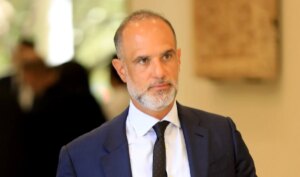
On the 48th anniversary of the disappearance of Imam Sayyid Musa al-Sadr and his two companions, the head of the executive body of the Amal Movement, Mustafa al-Fouani, reaffirmed that dialogue and national unity constitute the primary way to fortify Lebanon and confront strife and aggression, stressing that the constants of Parliament Speaker Nabih Berri represent a pillar for protecting the country’s unity, sovereignty, and stability.
Al-Fouani’s words came during a meeting organized by the Women’s Affairs Office in the Bekaa Region via the “Zoom” application, under the slogan “The honesty of a homeland and a thought that does not disappear,” on the occasion of the anniversary of the disappearance of Imam al-Sadr and his two companions.
Al-Fouani and the head of the central women’s affairs sector, Sister Amal Fahs, spoke during the meeting, while the head of the women’s affairs sector in the Bekaa region, Sister Souad Dabbous, presented the meeting.
Al-Fouani stressed that the anniversary of the disappearance of Imam al-Sadr and his two companions constitutes a station for drawing lessons and renewing commitment to the imam’s principles of nationalism, humanity, and resistance, stressing that the crime of disappearance did not only target the person of Imam al-Sadr, but rather targeted a national project that wanted Lebanon to be a homeland of justice, citizenship, and one coexistence, and for the Palestinian cause to remain present in the conscience of the nation.
He pointed out that President Nabih Berri’s speech in memory of Imam al-Sadr reaffirmed a set of national constants that constitute a basic foundation for protecting Lebanon and preserving its unity and stability, foremost of which is dialogue and convergence among the Lebanese, rejecting strife and division, and giving priority to the national interest over factional accounts.
Al-Fouani believed that Berri’s call for dialogue is not a circumstantial position, but rather reflects a solid national approach based on considering national unity and coexistence the basic guarantee for Lebanon’s survival.
He pointed out that Lebanon cannot confront internal and external challenges except through a unified national position that fortifies its internal arena and protects it from projects of fragmentation and division.
He stressed that the constant of Lebanon, “a final homeland for all its people,” established by Imam al-Sadr, constitutes the basis for building the state and protecting the formula of coexistence, stressing that this vision coincides with the constants that President Berri continues to affirm in terms of protecting Lebanon’s unity and sovereignty, and refusing to turn political difference into national division.
Al-Fouani stressed that confronting armed groups and Israeli aggression requires fortifying the home front and strengthening national unity, noting that Israel does not distinguish in its attacks between one Lebanese and another or between one region and another, which makes the unity of the Lebanese a national necessity in the face of Israeli ambitions and attacks.
Regarding the Palestinian issue, Al-Fouani reiterated that Palestine is not the issue of a group, faction, or sect, but rather the issue of the nation, humanity, and justice.
He pointed out that Lebanon has paid great prices since 1948 in defense of the Palestinian cause, and that southern Lebanon was and still is at the heart of the confrontation with Israel.
Al-Fouani called on the Women’s Affairs Office to respond to Speaker Berri’s call to fortify society, considering that protecting the nation does not begin only with political institutions, but also with the family, school, and society, and with building a conscious human being capable of confronting the culture of strife and division.
He stressed the importance of the role that women play in building families, creating awareness, and raising generations on the values of dialogue, tolerance, national belonging, and responsibility, citing Imam al-Sadr’s words: “We urgently need women who strengthen resolve and stand strong.”
Al-Fouani concluded by emphasizing that loyalty to Imam al-Sadr does not only consist of remembering his absence, but rather by carrying his project and adhering to its principles, most important of which are Lebanon’s unity, coexistence, and national dialogue, adhering to its sovereignty and rights, and continuing to stand by Palestine.
He stressed that these constants constitute a national trust and a renewed responsibility in confronting all attempts to strike Lebanon’s unity and weaken its national immunity.
In turn, the official in charge of the Central Women’s Affairs Sector, Sister Amal Fahs, began her speech by offering congratulations on the anniversary of the Prophet’s birth and the birth anniversary of Imam Al-Sadiq.
She said that the coincidence of the anniversary of the Prophet’s birthday with the anniversary of the disappearance of Imam al-Sadr entails several responsibilities for the women’s affairs sector, the most important of which is the constant striving for the best to achieve the status of a missionary woman.
She pointed out that the highest role model for women in life is embodied in Mrs. Fatima and Mrs. Zeinab with knowledge, piety, piety and steadfastness.
Fahs called for working to raise the cultural, educational and social level of women, empowering them and activating their participation and role within the family, society and in various fields.
She cited Imam al-Sadr’s words: “We must contribute to creating the appropriate climate for the growth of women’s competencies,” stressing that this comes as a service to society, because women are half of society, its beating heart, and its beautiful flower, and bear a great responsibility in education and human building.