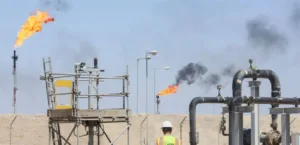
These forecasts, which are expected to be completed at the end of September and are used in preparing the budget, reduce oil production estimates for the period 2026-2029 by between 16 and 20 million tons, compared to the previous forecast published last May.
Since the start of the war with Ukraine in February 2022, the European Union has banned most imports of Russian oil and fuel, which is an important source of revenue for Moscow. In addition to export obstacles, the intense Ukrainian drone attacks on Russian oil refineries over the past months have led to a decline in fuel production. This caused a gasoline shortage across the country.
Basic scenario
In the base scenario, the government expects Russia’s crude oil production – the world’s third-largest producer – to fall by 17.2 million metric tons this year to 494.2 million tons, or 9.88 million barrels per day, the lowest level since 2009.
Crude oil production is expected to recover to 500 million tons next year, but will still be 16 million tons lower than previously forecast. Production is also expected to rise in 2028 and 2029, but will remain below 2025 levels.
Russian Deputy Prime Minister Alexander Novak, who is responsible for the oil file in President Vladimir Putin’s government, acknowledged in June that oil production in the country had declined since the beginning of the year, attributing this to unplanned maintenance work at refineries.
Reduced fuel production as a result of drone attacks has led to increased crude oil exports, particularly to China and India.
According to preliminary forecasts, Russia’s crude oil exports may reach 244.7 million tons this year, up from 230.8 million tons in 2025, an increase of 7.5 million tons from previous expectations.
As for next year, crude oil exports are expected to decline to 232.5 million tons, then to a sharp decline to 216.6 million tons in the period 2028-2029.
To address the shortage in the local market; Russia has imposed a ban on diesel exports, as well as restrictions on sales of gasoline and jet fuel abroad.
As a result; The Russian government expects fuel exports to decline by 27.3 million tons this year to 98.5 million tons, 24.1 million tons less than its previous forecast.
While fuel exports are expected to rise to 113.1 million tons next year, they will be about 13 million tons less than the 2025 level, and 21 million tons less than previous expectations.