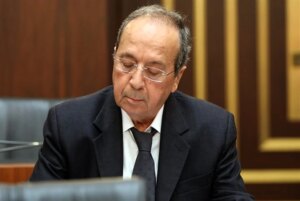
Representative Dr. Salim Al-Sayegh considered that “the circumstances that Lebanon is going through are very difficult, as the fate of the country will be determined during the next few months,” stressing that Lebanon is passing through an “entity moment” that cannot tolerate a return to the logic of settlements or linking the conflict.
Al-Sayegh’s speech came during a dinner party for the Kfardebian section of the Lebanese Phalange Party, where he touched on the House of Representatives’ decision to abolish the death penalty, linking it to the case of the martyr Joe Akiki.
He said: “A few days ago, the House of Representatives took the decision to abolish the death penalty, and before that we were in Kfardebian praying for the repose of the soul of the martyr and the victim at the same time as Akiki,” considering that abolishing the penalty would allow justice to be achieved, after countries, especially Bulgaria, refused to extradite accused persons to Lebanon due to the existence of the death penalty.
He added, “This is not a partisan, sectarian, or regional achievement, but rather a national achievement that deserves attention and praise.”
Regarding the political and security file, Al-Sayegh said that “the fate of Lebanon, its identity and its regime are now being discussed in decision-making capitals,” considering that the main question raised relates to the fate of Hezbollah’s weapons north of the Litani if the experimental areas succeed in removing them south of the river.
He asked: “If Hezbollah insists on keeping its weapons north of the Litani, will international interest in Lebanon remain? What will be the fate of the weapons from Sidon to northern Lebanon?” adding: “From here, from Kfardebian, I say very clearly and I repeat with the head of the party, MP Sami Gemayel: We will not coexist with this weapon that is outside Lebanese legitimacy.”
He stressed that “this issue has been settled and there is no turning back, and we will not return to a dispute again,” adding: “Our children have the right to hand over Lebanon to them with a clean homeland that resembles them.”
Al-Sayegh said: “Today we are in an existential moment and not in a time of scoring political points against each other, and we will remain united in the face of the question: Lebanon remains or does not remain.”
In response to those who say that the army cannot fight Hezbollah, he said: “Who said we want that? We want the Lebanese army to extend its control and sovereignty over Lebanese territory, and we want it to maintain security and protect its people. We want a demilitarized Beirut, and this decision was taken, but implementation is faltering.”
He stressed that the decision to make Beirut demilitarized had been taken, asking: “If the national decision taken by the government is not implemented, how can the army extend its authority over the entire Lebanese territory? The basis is the capital, and from it sovereignty extends to affect all borders, and the lack of implementation does not give reason for reassurance.”
He added: “If some countries want to return to linking the conflict with the party’s weapons, this is something that is rejected by us, and does not resemble the state that we sought with President Bashir Gemayel, and does not resemble President Joseph Aoun’s oath of office.”
Al-Sayegh addressed friendly countries by saying: “Be careful not to ask the Lebanese interior to return to linking the conflict with the party’s weapons,” considering that the cost of the previous experiment was “thousands of kilometers of tunnels and military structures that are said to have extended from Baalbek Castle to the barren lands of Keserwan and Jbeil.”
Al-Sayegh touched on the file of the Mount Lebanon commons, pointing out that the State Shura Council took a decision two weeks ago to stop the Minister of Finance’s decision to place the state’s hand on these commons, considering this “a recorded achievement for the Lebanese Phalange bloc in order to preserve the ownership of lands owned by the people of villages and towns.”
He explained that this file has had a special system since the Mutasarrifate of Mount Lebanon, noting that the Maronite Patriarch, Cardinal Bechara Boutros Al-Rai, spoke about the issue, which necessitated a visit by the Minister of Finance to Bkerke to clarify his decision.
Al-Sayegh stressed that “it is our duty to work to strengthen the army because the alternative is chaos and migration,” addressing those betting on the Iranian-American negotiations by saying that “any negotiation, regardless of its results, if we are not present to receive its results, becomes a lost opportunity like a large number of opportunities that we were not able to benefit from.”
For his part, the head of the Keserwan al-Futuh region in the Phalange Party, lawyer Michel Hakim, affirmed that “the Kfardebian dinner is not just a table, and the meeting is not just an occasion,” adding: “Where the mountains touch the sky, and where we learned that whoever stands firm on the ground will not be shaken by storms, we meet tonight at the table of loyalty, and we raise the cup not only in celebration of the present, but also in loyalty to the past and faith in the future.”
Hakim said, “The Phalange is not a memory to be told, but rather a march told with sacrifices. It is not a slogan that is raised but rather a cause that is carried. It is not a party that lives on the glories of yesterday, but rather a national school that has believed since its inception that Lebanon is not a detail on the margins of history, but rather a homeland complete with sovereignty, freedom and dignity.”
He pointed out that the Phalangists were present in the various stages of the Lebanese state. “They defended Lebanon when defense was a price, and preserved its identity when the identity became a target. Some of them fell as martyrs because they believed that the homeland was worth more than words, and that freedom was worth more than wishes.”
He added that “the march was not easy,” considering that Lebanon’s path was always difficult and full of choices, conspiracies, and great sacrifices, and that “the Phalange remained standing. It stood on a day when standing was heroism, it stood on a day when steadfastness was a testimony, and it continued on a day when it was a challenge to continue.”
Hakim asked: “Is it possible that all these sacrifices were made for the sake of an incomplete state? Is it reasonable that the dream of the martyrs is for Lebanon to remain a prisoner of settlements, a hostage of the axes, or a follower of a decision that comes to it from outside its borders?”
He stressed that “the time has come to translate the dream of Sheikh Bashir Gemayel and the dream of every martyr who fell for Lebanon into a project for a real state, a free state, not dependent, sovereign, not permissible, strong, not humiliated, one, not two states, and its decision will be from Beirut, not from outside the borders.”
He added: “We do not want a state on paper, nor sovereignty in speeches, nor independence during holidays. We want a state that exercises sovereignty over all of its territory, monopolizes alone the decision to decide peace and war, protects its borders, safeguards its institutions, and imposes the law on everyone without exception.”
He continued: “There is no state with two decisions, no republic with two weapons, no sovereignty with a state, and no independence with subordination,” considering that Lebanon is tired of the state being the weakest link and the citizen paying the price for decisions he did not make.
He stressed that the position of the Phalange Party, as expressed by the party’s head, Representative Sami Gemayel, is “clear and firm: There is no establishment of true Lebanon except with the establishment of the state, and there is no establishment of the state except with its complete sovereignty, and there is no complete sovereignty if the decision of war and peace is not exclusively in the hands of the Lebanese constitutional institutions.”
In turn, Head of the Kfardebian Department, Tony Saqr, welcomed the attendees, noting that the occasion comes on August 21, the day before the anniversary of President Bashir Gemayel’s election as President of the Republic.
He said, “The world has turned around and the years have passed, and now the truth is emerging, and here is President Joseph Aoun walking on the same path that Bashir Gemayel walked, and after him President Amin Gemayel walked.”
The dinner was attended by the coordinator of Kesrouan Al-Futouh in the Lebanese Forces, Sannine Baino, the commissioner of Kesrouan Al-Futouh in the Free Patriotic Party, Dory Khairallah, Dr. Josephine Zogheib, Louis Joseph Abu Sharaf, the mayor of Kfardebian Jean Al-Aqiqi, members of the municipal council and the mayors of the town, the president and members of the municipal council of Baqaata Kanaan, the director of the public school in Kfardebian Laila Salama, the mayor of the town of Faraya, and the head of the Al-Aqiqi Association. And the parish priest of Mar Ephrem George Nakhoul, in addition to religious, social, party and sports bodies.