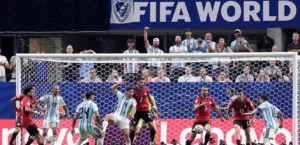
Despite Argentina’s steadfastness until the final minutes, Spain was the better side for most of the match, and succeeded in imposing its style thanks to five main factors that made the difference. 1- Control of the midfield.
The first factor was controlling the midfield.
The Spanish team kept the ball for long periods and managed the match at a pace that suited it, while Argentina retreated to its areas and relied on closing spaces and waiting for an opportunity to launch a counterattack. This style kept play in the Argentine half and allowed Spain to maintain pressure.

2- Isolating Messi from the rest of the team
The Spanish national team also succeeded in isolating Lionel Messi from the rest of his teammates.
After an early attempt that was blocked by Unai Simon, the Argentine captain did not get the spaces he needed, and there were no effective passes between him and the front line, which limited Argentina’s offensive threat.

3- Continuous pressure from the parties
The parties gave Spain a clear advantage, especially through the movements of Lamine Yamal, Cucurella and Nico Williams.
The Spaniards continued to move the game between the two sides and send balls into the penalty area, forcing the Argentine defense to retreat and make a great effort in coverage. Goalkeeper Emiliano Martinez excelled in the face of Spanish chances, and prevented more than one dangerous attempt before Torres’ goal.

4- Smart handling of Enzo Fernandez’s expulsion
Enzo Fernandez’s expulsion came in the 92nd minute, making the task more difficult for Argentina.
Spain took advantage of the numerical superiority without haste, and Neco Williams scored a disallowed goal in the 96th minute, before the pressure continued until the 106th minute, when Williams headed the ball to Torres, who scored the winning goal.

5- Physical superiority and patience until the 106th minute
The fifth factor was physical superiority during extra time. Spain maintained its ability to press and create opportunities, while Argentina’s attacking presence declined completely. The Spaniards shot 11 balls during this stage, while the Argentine team did not score any attempts. Torres also scored a second goal in the 112th minute that was ruled out for offside.
According to the course of the match, Enzo’s expulsion was not the only reason for Spain’s victory, but rather a factor that strengthened a superiority that had existed since normal time. The Spanish national team controlled the ball, kept Messi away from areas of influence, and maintained his physical and offensive ability until he scored the goal that gave him the title.