The confrontation between the United States and Iran has entered a new phase of escalation, after the Iranian Revolutionary Guard threatened to completely close the Strait of Hormuz to oil and gas exports, holding Washington responsible for any repercussions that may result from the continuation of American military operations against Iranian targets.
The Iranian threat came after US forces announced that they had targeted coastal surveillance radar sites on the islands of Qeshm and Gork, in response to Tehran launching drones towards the Strait of Hormuz, in one of the most dangerous episodes of ongoing confrontation between the two sides since the outbreak of the war.
The Revolutionary Guard said in a statement that the United States “will be responsible for the consequences of the complete closure of the Strait to oil and gas exports if American harm continues,” stressing at the same time that it carried out missile attacks targeting American bases in Kuwait and Bahrain in response to the recent strikes.
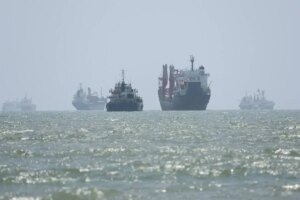
The Revolutionary Guard also announced that it had opened fire on four tankers that were trying to cross the Strait of Hormuz without obtaining permission from it, in a move that reflects the extent of the escalating tension in one of the most important strategic sea lanes in the world.
On the other hand, the US military command announced that Iran launched seven ballistic missiles towards Kuwait and Bahrain, confirming that the defense systems were able to intercept six of them, while the seventh missile did not reach its target.
The US Army stressed that no casualties were recorded among the US forces, denying what it described as “false Iranian allegations” regarding targeting the headquarters of the US Fifth Fleet in Bahrain or causing damage to it.
This escalation came after Kuwait and Bahrain witnessed a state of security alert during the past hours, with explosions being heard and sirens sounding, while the authorities called on citizens and residents to remain calm and follow official instructions.
The military developments coincide with the faltering US-Iranian negotiations, which have reached a sensitive stage in recent days. According to available data, disagreements still exist over the issue of frozen Iranian funds and the mechanism for releasing them, in addition to the future of the Iranian nuclear program and freedom of navigation in the Strait of Hormuz.
Tehran insists that any future agreement include the release of billions of dollars of its frozen funds, and the easing of sanctions imposed on its oil exports, as well as ensuring its role in managing the security of the Strait of Hormuz. On the other hand, Washington rejects any restrictions on international navigation in the Strait and adheres to more stringent conditions in the nuclear file.
The Strait of Hormuz is one of the most sensitive sea lanes in the world, as about a fifth of the world’s seaborne oil supplies passed through it before the war. Therefore, any threat to close it or disrupt navigation raises widespread concerns in global markets and puts international energy security to a new test.
With international mediation, especially Pakistani, reaching a delicate stage, the region appears to be at a critical crossroads between reaching a political settlement that stops escalation or sliding toward a broader confrontation whose effects may extend beyond the Gulf and the Strait of Hormuz.