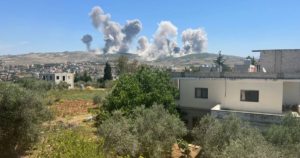
The Israeli army announced, through its spokeswoman Ella Wawiyeh, the start of a large operation in the Beaufort Heights and the Wadi Saluki area in southern Lebanon, in a new field development that places one of the most sensitive points in the south within the scope of direct confrontation.
Wawiya said, via the “X” platform, that the Northern Command had begun a military operation in the Beaufort Heights, also known as the Beaufort, and in the Wadi Saluki area, noting that its aim was to strike structures affiliated with Hezbollah and pursue its members, as part of what Israel described as strengthening operational control in southern Lebanon and removing a direct threat from the Galilee finger and the town of Metulla.
According to the Israeli announcement, the operation began several days ago, and large ground forces participated in it, including the Golani Brigade, the 7th Brigade, the Givati Brigade, the Fire Brigade, and the Multi-Dimensional Unit, under the command of the 36th Division and under intelligence guidance from the Military Intelligence Authority.
Wawiya indicated that Israeli Chief of Staff Eyal Zamir approved the operation, pointing out that the Israeli forces carried out advance combat preparations, which included fire preparations and operational procedures to prepare the field, before expanding the offensive activity in the region.
The operation, according to the Israeli narrative, focuses on imposing control over the Shaqif Heights and the Wadi Saluki area, and targeting sites that Israel says Hezbollah established in the highlands under Iranian guidance, and used them to manage the fighting and carry out operations against Israel and its forces operating in southern Lebanon.
Wawiya added that Israeli forces are also working against launching pads and structures in the region, which she said were used to carry out hundreds of launch operations towards Israel and Israeli army forces in southern Lebanon.
In a remarkable development, the Israeli army spokeswoman announced that its forces had crossed the Litani River and expanded their attacks against Hezbollah to the north of the river, noting that operations are expanding at this stage towards additional areas.
Before the entry of the forces, according to the Israeli statement, the Air Force launched intensive raids on Hezbollah structures in the region, within a broad fire cover that included artillery and tanks, while the forces carried out sweeping and neutralizing operations on military structures in the vicinity of the Litani, in addition to engineering works that they said were necessary to secure the conditions for the offensive operation.
The Shaqif region gains special importance in military and political calculations, given its high location overlooking large areas of southern Lebanon, and its proximity to Nabatieh, the Litani, and the roads that connect the southern villages to each other. Beaufort Castle also carries prominent historical and military symbolism, as it formed, during previous stages, a strategic control point in the conflicts that the south witnessed.
As for Wadi Saluki, it is considered one of the sensitive areas on the ground, due to the nature of its terrain and its connection to broad movement and surveillance axes in southern Lebanon. Hence, the Israeli announcement of an operation in this spot does not appear to be a passing detail, but rather comes in the context of an attempt to expand field pressure on Hezbollah, and move from sporadic air strikes to deeper and more complex ground operations.
This operation comes in light of a clear escalation in the south, where in recent days Israel has intensified its raids and evacuation warnings in a number of towns, coinciding with the continuation of the open confrontation with Hezbollah and increasing fears that the clash will move to a more extensive stage, especially after repeated Israeli talk about eliminating what it describes as threats near the border.
The announcement also coincides with increasing political sensitivity in Lebanon, in light of the continued search for security and political arrangements to reduce the escalation, amid Lebanon’s official adherence to the priority of a ceasefire and its refusal to jump into any other discussions before stabilizing this path. On the other hand, Israel is trying to impose new realities on the ground, whether by intensifying raids or by expanding the scope of ground operations.
The announced operation raises major questions about the limits of the Israeli escalation in southern Lebanon, especially since talk of crossing the Litani touches one of the most sensitive lines in the conflict, with its military and political dimensions linked to international decisions and arrangements after previous confrontations.
While Israel confirms that it will continue to work to remove every threat targeting it, all eyes remain on the field in southern Lebanon, where the Beaufort Heights and Wadi Saluki are turning into a new address in an escalation path that is still open to wide possibilities.