US President Donald Trump has increased the intensity of his rhetoric towards Iran, combining messages of military escalation with an emphasis on the continuation of the negotiating path, at a time when the region appears to be facing a very sensitive phase with faltering negotiations and escalating military preparations on both sides.
In this context, Trump praised the role played by Pakistan in mediating between Washington and Tehran, rejecting the idea of replacing it with any other mediator, and stressing that Islamabad plays a “wonderful” role in trying to bring the views of the two parties closer together.
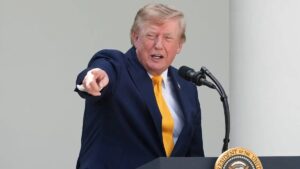
“The Pakistanis are great,” Trump told reporters, adding that Pakistani Army Chief of Staff Asim Munir and Prime Minister Shehbaz Sharif are “doing an excellent job” in managing the mediation related to the Iran-US negotiations.
Trump’s statements come despite the faltering round of talks hosted by Islamabad last month, which did not lead to any tangible breakthrough, amid continuing disagreements over the Iranian nuclear program and the future of the military calm in the region.
It also coincides with reports that sparked controversy within the US Congress about the possibility of deploying Iranian aircraft inside Pakistani territory to protect it from any possible US strikes. These reports have raised increasing concern within American political circles.
In parallel with the diplomatic track, Trump escalated his military tone in an unprecedented manner, announcing on the “Truth Social” platform that the United States had “completely destroyed” the Iranian naval fleet, saying that all Iranian ships “are now lying at the bottom of the sea.”
The US President also confirmed that Iran has also lost its air capabilities, adding that “Iran’s leaders are no longer among us,” referring to the strikes and assassinations that targeted Iranian military figures during the recent war.
These statements come despite recent American intelligence reports that spoke of Iran’s success in restoring most of its missile capabilities and underground military facilities, which reflects the continuing discrepancy between American political discourse and internal security assessments.
In a move that sparked widespread interaction, Trump also published artificial intelligence-generated images showing American attacks on Iranian ships and aircraft, and accompanied them with sarcastic and showy phrases such as “Goodbye fast ships” and “Laser: Ping Ping… gone.”
The pictures received millions of views on social media platforms, while observers considered them part of the psychological and media war that Washington is waging against Tehran, and a message of deterrence that carries political and military dimensions at the same time.
Others also saw that these publications reflect a deliberate escalation in American discourse, and may prepare public opinion for the possibility of a return to military operations if the current negotiations collapse.
In this context, American reports revealed that the Pentagon is considering renaming military operations linked to Iran under the title “Sledgehammer,” in the event of the collapse of the current ceasefire and the resumption of direct confrontation.
This comes in conjunction with escalating Iranian warnings, as Tehran confirmed that it will respond “immediately and firmly” to any new attack, considering that Washington must accept Iranian conditions or face “repeated defeats.”
The Iranian Revolutionary Guard also conducted military maneuvers inside Tehran during the past days, an indication of the continuation of field preparations despite the current negotiating path.
In light of this scene, the crisis between Washington and Tehran seems stuck between two parallel options: faltering negotiations that Pakistan is trying to save, and a mutual military and media escalation that raises the level of tension and makes the possibility of a return to open confrontation exist at any moment.