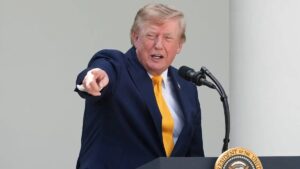
Iran responded with a sharp political and media escalation to US President Donald Trump’s threats to impose a naval blockade on the Strait of Hormuz, stressing that any such move would be tantamount to a declaration of war that would require an Iranian response.
Brigadier General Ismail Qaani, Commander of the Quds Force in the Iranian Revolutionary Guard, confirmed that “the United Resistance Front has a strong and effective presence in the entire region, and is on alert, waiting for the enemies of humanity,” adding that the United States and Israel “must remember how they left Yemen, Bab al-Mandab, and the Red Sea without achieving anything.”
Qaani pointed out that “the result will be the same now as well,” hinting that the fate of Washington and its allies will be to leave the region without achieving any of their goals.
In the same context, Ebrahim Rezaei, spokesman for the National Security and Foreign Policy Committee in the Iranian Shura Council, stated that “Trump has no choice but to accept defeat,” stressing that “the Iranian people cannot be defeated.”
Rezaei described Trump’s statements about imposing a naval blockade on Iran as “more pure deception than reality,” warning that any blockade of the Strait of Hormuz “will be considered a military operation and we will respond to it.”
He also pointed out that any American step in this strait would lead to “complicating the current situation and increasing market turmoil,” given the importance of this vital waterway through which a large portion of global energy supplies passes.
For his part, Haji Babaei, Deputy Speaker of the Iranian Shura Council, stated that “in light of the existence of the Strait of Hormuz, no country can impose sanctions on Iran,” adding that “the Strait of Hormuz and the masses in the streets are our atomic bomb,” referring to Iran’s reliance on its geographical location and popular power as pressure cards.
These statements come after Trump announced his intention to impose a comprehensive naval blockade on ships heading to and from Iranian ports, as part of a maximum pressure campaign that came after the failure of negotiations that lasted 21 hours in Islamabad without reaching an agreement.
The Strait of Hormuz is considered one of the most important waterways in the world, as a large volume of oil and gas passes through it, which makes any escalation in it directly reflect on energy markets and regional stability.
In light of the American threat of a maritime embargo and the Iranian warning against considering this an act of war, the region appears to be entering a very sensitive period, where military calculations are intertwined with the interests of the global economy, while the international community is monitoring the course of events and whether they will be limited to political pressures or turn into a broader conflict.