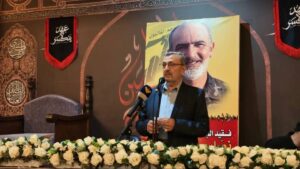
Representative Bilal Al-Hashimi opened a direct political confrontation with the head of the “Free Patriotic Movement,” Representative Gebran Bassil, against the backdrop of the controversy over the amnesty law and the challenge to it, considering that the challenge is a “constitutional right,” but using the issue of the army martyrs in the political debate constitutes, as he put it, “a political and moral fall.”
Al-Hashimi said in a statement that Bassil is deliberately addressing public opinion as if the law pardons military killers, noting that Article 2 of it excludes premeditated and intentional murder crimes, and terrorist crimes committed against civilians and military personnel, in addition to military crimes.
He added that Bassil “either did not read the law, or he read it and chose to mislead the Lebanese,” considering that he does not have the right to use the blood of the martyrs for political and electoral incitement.
Al-Hashimi recalled the events of the wars of liberation and abolition in 1989 and 1990, speaking about the fall of more than a thousand martyrs and thousands of wounded and displaced people during the period in which General Michel Aoun was commander of the army and head of the transitional military government. He asked who was held accountable during that stage and who apologized to the families of the victims.
He also pointed out that Aoun benefited from Decree No. 1637 issued on August 28, 1991, which granted him a special pardon with the effects of a general amnesty based on Amnesty Law No. 84/91, wondering why the amnesty was considered a national reconciliation at the time, and is considered a crime today when it includes other citizens.
Al-Hashimi moved to the weapons file, accusing the Free Patriotic Movement of having, during the years of the Mar Mikhael Agreement, provided political cover for weapons outside the state and for an equation that kept the decision on war and peace outside legitimate institutions, considering that it is not possible to bring in the army and martyrs when there is a need for a populist and electoral battle.
He also recalled what was attributed to Bassil, when he was Minister of Communications, who described the downing of the army helicopter and the martyrdom of Pilot Captain Samer Hanna in 2008 as having occurred as a result of “friendly fire,” wondering about his position on that day.
Al-Hashimi stressed that the law was approved by the House of Representatives, signed by the President of the Republic, and published in the Official Gazette under No. 70, stressing that challenging it is a constitutional right, but “falsifying its content and mobilizing instincts” do not constitute a defense of the constitution or the military institution.
He concluded by saying: “We are not afraid of your appeal, and let the Constitutional Council have its say. But enough of hiding behind the army, and enough of investing in the blood of its martyrs to restore lost popularity,” adding that “justice is indivisible, the martyrs are not the property of the movement, and the army is not an electoral platform,” and that loyalty to the military establishment is through the establishment of “one state, with one army, one decision, and one legitimate weapon.”