“Lebanon Debate”
A judicial complaint, said to have been filed by the Supreme Islamic Shiite Council against director Youssef Al-Khoury, against the backdrop of statements deemed insulting to the Karbala incident and the martyrdom of Imam Hussein and his companions, ignited a religious and political debate that went beyond the boundaries of disagreement over the reading of a historical event, to open a broader debate regarding freedom of expression and respect for the sacred.
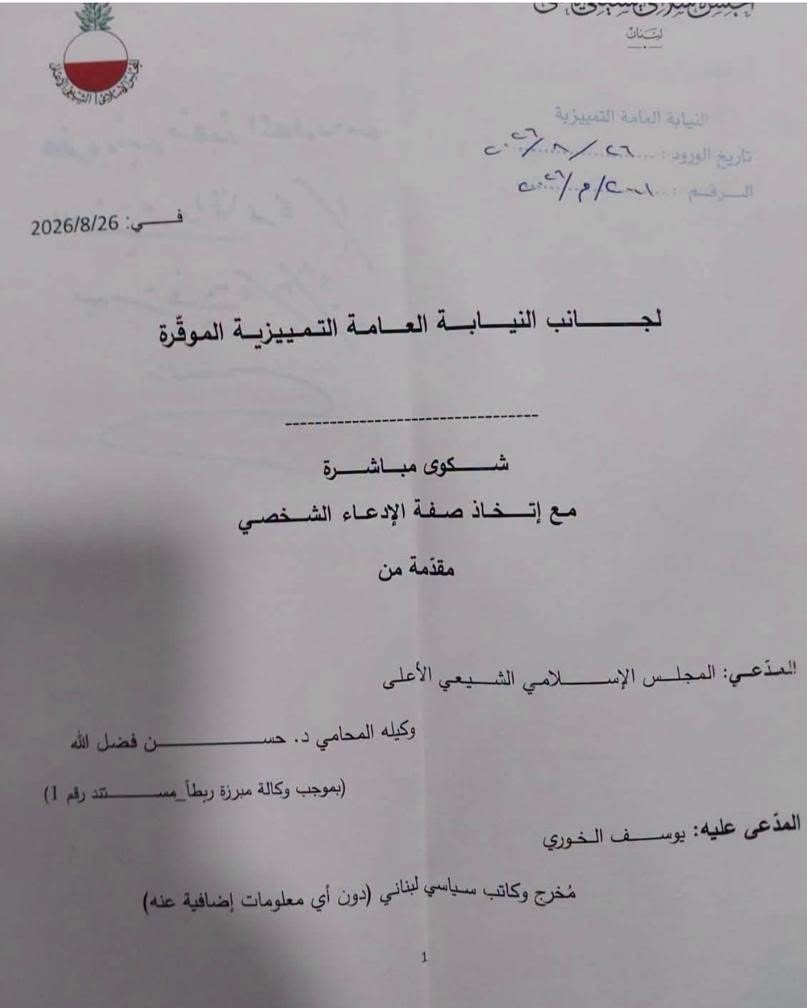
Speaking to Lebanon Debate, Al-Khoury confirmed, “He has not been officially informed of the complaint yet, and he does not know its legal content or the phrases contained in it,” noting that “he learned of it after the Council announced it in the media.”
He considered, “Raising this file comes at a time when the south is on fire, while some are busy returning to an event that occurred about 1,400 years ago,” adding, “The priority must be what Lebanon is exposed to today.”
Al-Khoury rejected the accusations directed against him of insulting Imam Hussein, stressing, “His speech dealt with the Battle of Karbala as a historical and military incident, and did not address the religious doctrine or beliefs of the Shiite sect.”
He explained, “His position came in response to Hezbollah Secretary-General Naeem Qassem’s talk about the possibility of fighting a Karbala battle,” pointing out, “He used the description of suicide to indicate entering into an unequal military confrontation, not to insult Imam Hussein.”
He said, “When the balance of power is unequal and the entire country is pushed into confrontation, the danger does not affect one party, but rather pushes Lebanon and the Lebanese towards suicide,” stressing that “the issue for him is related to those who invoke Karbala today to justify a new war, not Imam Hussein himself.”
In his response to lawyer Hassan Fadlallah, who accused him of being ignorant of the history of Karbala and mixing martyrdom with suicide, Al-Khoury believed, “Fadlallah attributed to him something he did not say, and turned a political and military position into an ideological insult.”
He added, “I did not insult Imam Hussein, but rather I presented a reading of a historical battle that witnessed a major imbalance of power,” stressing, “The debate must remain based on what was actually said, not on interpretations presented as facts.”
Fadlallah had responded to Al-Khoury, saying, “The Karbala incident does not represent suicide, but rather a stance in the face of injustice and a refusal to pledge allegiance to an unjust ruler,” stressing that “Imam Hussein was besieged and faced with the choices of allegiance or killing, and that his sacrifice became a symbol of human dignity and steadfastness in the truth.”
Fadlallah also considered, “Describing the incident as a suicide affects the beliefs of a large segment of the Lebanese,” stressing, “The Supreme Islamic Shiite Council resorted to the judiciary in accordance with legal principles in defense of the sanctity of the sacred and to prevent sectarian incitement.”
Al-Khoury responded to this approach by saying, “The account presented by Fadlallah includes that Imam Hussein asked to be allowed to leave, which, in his opinion, calls for a historical discussion far removed from slogans and ideological descriptions.”
He stressed, “He will not back down from his position or stop expressing his political opinions,” considering, “Resorting to the judiciary may be an attempt to silence a voice that criticizes the choices that the country is being pushed towards.”
Al-Khoury expressed his fear that the file would turn into a prosecution that goes beyond the scope of the current complaint, but he stressed that “he will continue to speak, respond, and clarify his position, and will not accept that an offense he did not commit is attributed to him.”
Thus, the dispute moved from describing the Battle of Karbala and evoking it in contemporary political discourse to an open judicial and intellectual confrontation, which put freedom of expression and the sanctity of the sacred to a very sensitive test. Between Al-Khoury’s insistence on his right to present a political and historical reading, and his opponents’ insistence on considering his words a religious insult, the final say remains for the judiciary, while the debate continues over the line between legitimate criticism and attacking beliefs.