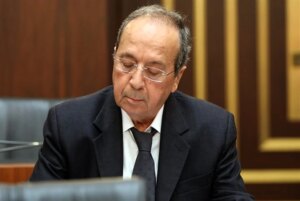
The head of the Baalbek-Hermel bloc, MP Hussein Haj Hassan, confirmed his rejection of the option of direct negotiations with Israel, considering that it constitutes a constitutional and legal violation and carries great risks for Lebanese national interests.
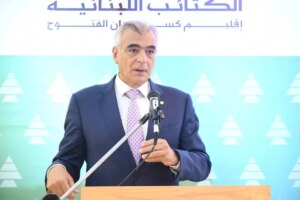
Hajj Hassan’s words came during a festival held by the “National Banner” Party in Baalbek under the title, “Loyalty and thanks to the Islamic Republic of Iran for its support of Lebanon, its people, and its resistance, and rejection of the agreement of shame and the path of political authority,” in the presence of political, religious, party, and municipal figures.
Hajj Hassan stressed that the framework agreement signed by the authority includes, as he put it, concessions affecting basic national issues, most notably the return of the displaced, liberation, reconstruction, and resistance weapons.
He said that the authority will not be able to disarm the resistance, warning that “any foreign force that the authority may summon for this purpose is an occupying force,” and that any path in this direction represents a project of sedition for which the authority bears responsibility and its consequences.
Hajj Hassan accused the authority of linking crucial Lebanese issues with Israel’s approval and of choosing experimental areas subject to monitoring, completely rejecting this mechanism, and considering that a number of the towns proposed within these areas were unable to be entered by Israeli forces during the confrontations.
He also criticized what he described as Lebanon’s waiver of its right to pursue Israel before the courts, at a time when, according to him, killings, destruction, and targeting of Lebanese homes, institutions, and towns continue.
He pointed out the widening circle of objection to the framework agreement, considering that political forces and figures who were not affiliated with the resistance line have begun to reject it because of the repercussions it has on sovereignty, security and stability.
Regarding the Iranian issue, Hajj Hassan praised the support provided by Tehran to Lebanon and the resistance forces, stressing that Iran placed Lebanon at the heart of its understandings with the United States, especially with regard to the ceasefire and complete Israeli withdrawal.
In turn, the head of the “National Banner” Party, Ali Hegazy, said that Iran sacrificed its interests for the sake of Lebanon, considering that it had stood by its side in confronting Israel since the liberation in 2000 and the 2006 war, up to the recent confrontations.
Hegazy confirmed his rejection of the framework agreement, describing it as an “agreement of humiliation and shame,” and considering it to be morally, politically, constitutionally, and popularly deficient.
He stressed that the weapons of the resistance will remain protected, saying that the real goal of the pressure is to remove the missiles that pose a threat to Israel, stressing that what Israel was unable to achieve by force will not be achieved through agreements or guarantees.
Hegazy also criticized what he described as the exclusion of the forces that rejected the agreement from the official meetings, calling on the President of the Republic to give the National Front a date to present its position and discuss the agreement.
For his part, the head of the “National Center in the North,” Kamal Al-Khair, considered that the framework agreement would not pass constitutionally, legally, or popularly, calling for resorting to a popular referendum on direct negotiations with Israel.
The festival included positions by Rafi Madian, secretary of the “Independents Meeting for Lebanon,” and Shaker Al-Barjawi, head of the “Arab Movement,” in which they affirmed support for the resistance option and rejection of direct negotiations and the framework agreement.