Anti-armor missiles or conventional missiles no longer top the list of Israeli concerns on the northern front. According to Israeli estimates, the bomb-laden drones used by Hezbollah have become the most dangerous threat to the Israeli forces, after they succeeded, within a few weeks, in changing the rules of confrontation and imposing a new equation of attrition on the Israeli army.
According to a report by journalist Anat Bild in the Wall Street Journal, Hezbollah fighters have become more professional in operating suicide drones, taking advantage of night vision technologies and first-person perspective (FPV) control systems, the same technologies that emerged strongly in the Ukrainian war.
The report indicates that bomb-laden drones have become the main cause of deaths among the Israeli army, as they are behind the deaths of 7 out of 11 Israeli soldiers who fell since the fragile ceasefire between Lebanon and Israel entered into force last April.
Video clips published by Hezbollah on social media show the use of FPV drones to target fuel tanks in Israeli military vehicles, a technique used by fighters in Ukraine to cause larger explosions and achieve the greatest amount of damage.
The report also revealed that the party began using night vision technologies, in addition to operating drones inside Israeli territory, a development that Tel Aviv considers very disturbing.
These developments come in conjunction with the ongoing negotiations between Washington and Tehran, as Iran insists that any potential agreement must include stopping the fighting in Lebanon. In return, Israel is pressuring the US administration to obtain understandings that allow it to continue military action against Hezbollah.
The recent attacks led to escalating internal pressure on Israeli Prime Minister Benjamin Netanyahu to take more severe steps against the party, after the marches revealed what the report described as an “Israeli weak point,” and returned Hezbollah to the initiative after the harsh blows it had previously been subjected to.
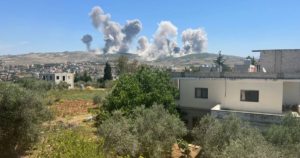
After these pressures, Netanyahu announced that Israel would strike “with greater force” in Lebanon, stressing the expansion of ground operations and control of more areas, while the Israeli army intensified its raids on southern Lebanon and issued widespread evacuation orders for the civilian population before carrying out new strikes.
Experts in the field of drones believe that Hezbollah’s success is not only due to the development of its tactics, but also to Israeli defensive mistakes, including the gathering of soldiers and vehicles in exposed and insufficiently protected locations.
The report indicated that the Israeli army began deploying protection networks over military sites and vehicles, and also accelerated training programs for confronting drones, in parallel with targeting drone manufacturing and launching sites in southern Lebanon.
In testimony that reflects the extent of anxiety within Israel, Tanya Koronos, a resident of the town of Adamit near the Lebanese border, said that she saw a drone flying over her area, but she no longer cared due to the psychological exhaustion resulting from the repeated warnings.
She added: “I am angry with the government and decision-makers. Either they go forcefully and completely dismantle Hezbollah’s capabilities, or they conclude a real and viable agreement.”
The report reveals that about 80% of Hezbollah drones are controlled via fiber optic cables, making them largely immune to Israeli electronic jamming systems.
An Israeli security official was also quoted as saying that the army was able to eliminate only “a small number” of the party’s drone operators, although their number is estimated at dozens.
In his assessment of the scene, American expert Samuel Bendet said that Hezbollah drone operators accumulate experience with every mission they carry out, whether it succeeds or fails, adding: “This is how things are developing in Ukraine.”
As for former Ukrainian officer Dmytro Butiata, he considered that what he saw in Hezbollah clips reminded him of the mistakes committed by the Russians at the beginning of the Ukrainian war, criticizing Israeli defensive measures and stressing that they are still far less than what is required to confront this type of threat.
The report concludes by noting that the Israeli soldiers deployed in southern Lebanon confirm that the party has begun conducting marches at night as well in recent days, while what they currently possess is limited to covering equipment and weapons with protective nets, in a scene that reflects how the marches have transformed from a secondary weapon into one of the most prominent elements of force in the ongoing confrontation on the Lebanese front.