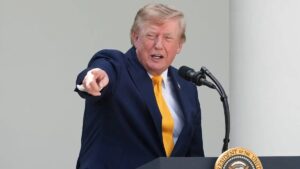
In an unprecedented session in the US House of Representatives, Democratic Representative Adam Smith launched a scathing attack on US President Donald Trump, during a hearing in the Armed Services Committee attended by Defense Secretary Pete Hegseth to discuss the war on Iran.
Smith considered that Trump’s talk about “Iran’s surrender” does not reflect reality, describing it as a “mental trick,” stressing that Tehran did not even agree to hold a meeting with American officials, in addition to the absence of any indications that it was abandoning its nuclear or missile program.
He pointed out that what has been achieved so far is considered “tactical successes,” but it has not fundamentally changed Iran’s capabilities, whether with regard to ballistic missiles or the possibility of influencing navigation in the Strait of Hormuz.
In his criticism, Smith reviewed the cost of the war, speaking of the fall of 13 American soldiers, the injury of hundreds, in addition to thousands of civilian casualties, and the involvement of more than 12 countries in the conflict, which reflects its breadth.
He also pointed to the economic repercussions, especially the rise in fuel prices by more than a dollar per gallon, and the possibility of an increase in food prices globally as a result of supply chain disruptions, especially in the fertilizer sector.
Smith criticized the Pentagon’s request to increase its budget by up to 60%, in light of an American debt amounting to about 40 trillion dollars, questioning the efficiency of spending this money, at a time when the Pentagon has not passed a full financial audit.
He also touched on international relations, considering that Trump’s policies are pushing allies away, citing the tension with French President Emmanuel Macron, and noting the difference in American dealings between Vladimir Putin and Volodymyr Zelensky.
He also raised a sensitive issue related to the behavior of American forces during the war, speaking of a “mistake” represented by the bombing of a girls’ school at the beginning of operations, warning that escalatory rhetoric, including the threat to “exterminate civilizations,” harms the image of the United States and undermines confidence in it globally.
This confrontation within Congress reflects the extent of the political division in Washington over the management of the war on Iran, between those who see it as a strategic necessity, and those who consider it to be costly and whose consequences are unpredictable.