Two months after the outbreak of war with the United States and Israel, the governance structure in Iran appears to be undergoing an unprecedented transformation, with the absence of a single decisive authority at the top of the power pyramid, which has reflected a hardening of Tehran’s positions, at a time when it is considering resuming talks with Washington.
Since the establishment of the regime in 1979, the position of Supreme Leader has been the center of gravity in political and military decision-making. However, the killing of Ali Khamenei on the first day of the war on February 28, and the election of his son Mojtaba Khamenei despite his injury, led to the emergence of a new reality characterized by multiple decision-making centers.
According to informed sources, Mujtaba’s role no longer goes beyond legitimizing decisions formulated within military and security circles, instead of being the final decision-maker. Data indicate that actual power today is concentrated within a narrow circle that includes the Iranian Revolutionary Guard, the Supreme National Security Council, and the Supreme Leader’s office.
In this context, the name of Ahmed Wahidi emerged as one of the most prominent interlocutors and decision-makers on the ground, at a time when the influence of military leaders increased at the expense of traditional political institutions.
This overlap in decision-making centers was directly reflected in the negotiating track, as a Pakistani official familiar with the talks revealed that “the Iranians are painfully slow in their responses,” pointing to the absence of a unified leadership structure, which sometimes leads to delaying responses for several days.
On the other hand, analysts believe that the complexity is not only related to internal conflicts, but also to the large gap between what Washington is offering and what the hard-line movement in Iran can accept, especially in light of the dominance of the Revolutionary Guard.
At the diplomatic level, Foreign Minister Abbas Araqchi is leading the negotiations, with the participation of prominent figures such as Muhammad Baqir Qalibaf, who played the role of a link between the political and military wings.
On the other hand, the presence of extremist figures such as Saeed Jalili has increased in public discourse, without having the institutional ability to impose their views or disrupt decisions.
Sources indicate that the rise of Mojtaba Khamenei was closely linked to support for the Revolutionary Guard, which worked to marginalize pragmatic movements and strengthen its position as a guarantor of a more hardline agenda.
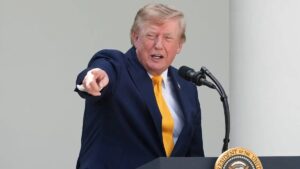
In parallel, US President Donald Trump continues to talk about the “weakness” of the Iranian regime, stressing that the leadership in Tehran is suffering from a state of division, in a description that reflects the American reading of the ongoing transformations within Iranian government institutions.
These transformations reflect a changing governance structure under the pressure of war, as military institutions come to the fore at the expense of traditional authorities. Between the multiplicity of decision-making centers and the increasing influence of the Revolutionary Guards, Iran is moving towards a more stringent model at home and abroad, which will directly reflect on the course of the negotiations and the possibilities of calm or escalation in the next stage.