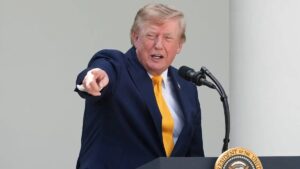
A White House advisor said that the US administration keeps all options on the table regarding dealing with Iran, pointing out that President Donald Trump is seeking to reach a “safe and secure final solution” to the existing crisis.
The official stated that the United States is able to continue the naval blockade imposed on Iran “indefinitely,” considering that these measures represent an effective means of pressure on the Iranian regime’s economy, and aim to limit its financial resources as part of a broader strategy aimed at pushing Tehran to change its behavior and engage in a comprehensive settlement.
The US Central Command (“CENTCOM”) announced that the blockade, which began implementation last Monday, coinciding with the ceasefire between the United States and Iran, included the deployment of about 10,000 American soldiers, and more than 12 US Navy warships stationed in the Gulf of Oman and the Arabian Sea, in addition to a group of combat aircraft and drones to monitor the movement of commercial ships in the region.
This naval and air deployment shows the extent of American dependence on simultaneous economic and military pressure, in an attempt to restrict the movement of Iranian exports and imports through vital sea lanes.
On the other hand, Tehran stated that it has land alternatives for export and import through neighboring countries, in an attempt to reduce the impact of the blockade. However, economic experts confirmed that the maritime closure may cost the Iranian authorities daily losses estimated at about $350 million, which will increase financial pressure on the Iranian government and reduce its ability to finance its internal and external obligations.
This naval escalation comes in the context of an open confrontation between Washington and Tehran, combining economic pressures, military movements, and an undecided negotiating path. While the US administration declares that its goal is to reach a comprehensive agreement that guarantees regional security and restricts the Iranian nuclear program, it is betting on a policy of “maximum pressure” to push Tehran to make major concessions.
In light of the continuation of the blockade and the deployment of thousands of soldiers and warships in sensitive territorial waters, the question remains about the extent to which this pressure is able to impose a quick settlement, or whether the region is heading towards a long-term stage of attrition in which military, economic and political calculations overlap.