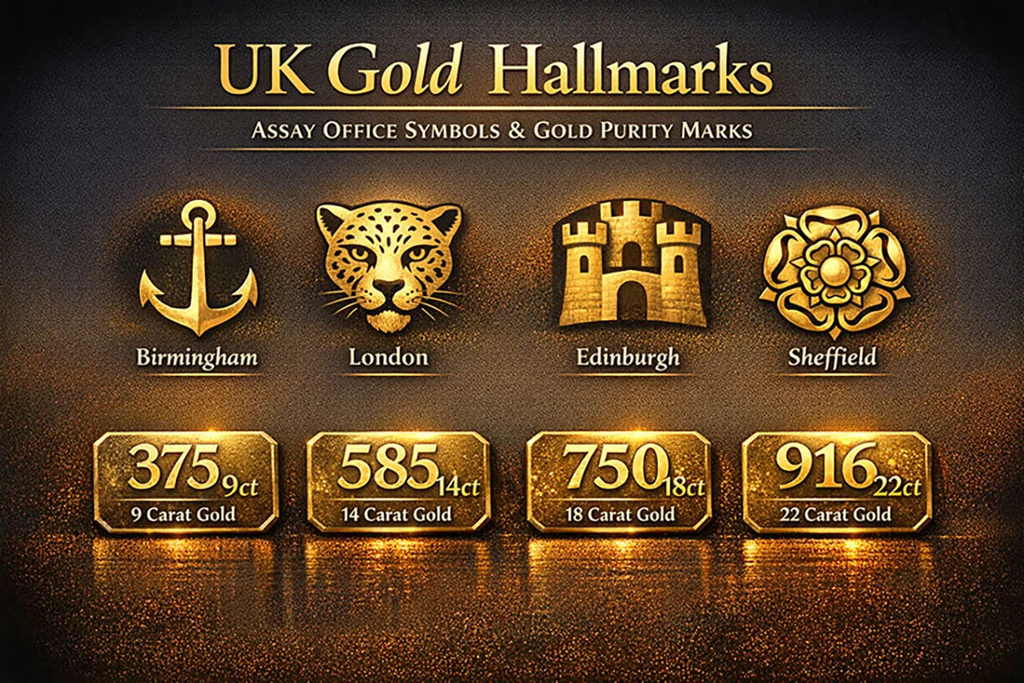
Welcome to the definitive guide and visual reference for antique gold hallmarks identification in the UK (how to date, verify, and value inherited British gold jewelry). When sorting through estate heirlooms, vintage signet rings, pocket watches, or antique pocket chains, deciphering the tiny stamped impressions inside the metal is the single most important step to unlocking their true market value.
Unlike modern jewelry produced overseas, British gold possesses a rich 700-year history of statutory hallmarking. Before selling an old piece for raw scrap melt value, understanding these historic marks ensures you never accidentally liquidate a rare Victorian or Georgian masterpiece for a fraction of its true secondary collector value.
Live Gold Price Reference (GBP Benchmark)
The Anatomy of a Traditional British Hallmark
Under statutory British standards codified by the Hallmarking Act, a complete historic British hallmark contains up to five distinct individual punch marks struck in a clean row:
 ┌───────────────┬───────────────┬───────────────┬───────────────┬───────────────┐
 │ SPONSOR MARK  │ STANDARD MARK │ ASSAY OFFICE  │  DATE LETTER  │ DUTY MARK     │
 │  (Initials)   │  (Fineness)   │   (Town Mark) │    (Year)     │  (Sovereign)  │
 ├───────────────┼───────────────┼───────────────┼───────────────┼───────────────┤
 │   e.g. "W.B"  │   Crown + 18  │ Leopard Head  │      "a"      │ Monarch Head  │
 │  Maker/Smith  │   18ct (750)  │ London Assay  │     Year      │ Tax Paid      │
 │  Origin ID    │   Pure Gold % │ Verification  │  1776 - 1998  │ (1784 - 1890) │
 └───────────────┴───────────────┴───────────────┴───────────────┴───────────────┘
1. The Purity Standard Mark: Distinguishing 9ct, 15ct, 18ct & 22ct
The standard mark confirms the millesimal fineness of the gold alloy. Prior to the adoption of decimal numbers in modern conventions, antique pieces featured classic symbolic standards alongside numerical stamps:
| Carat Purity | Antique British Symbols | Decimal Fineness | Historical Era & Use |
| 22 Carat (22ct) | Crown + 22 | 916 (91.67%) | Standard for traditional wedding bands & Sovereigns |
| 18 Carat (18ct) | Crown + 18 | 750 (75.00%) | Established standard for fine jewelry since 1798 |
| 15 Carat (15ct) | 15 + .625 | 625 (62.50%) | Discontinued in 1932 (Highly sought-after Victorian hallmark) |
| 14 Carat (14ct) | 14 + .585 | 585 (58.50%) | Introduced in 1932 to replace 12ct and 15ct standards |
| 12 Carat (12ct) | 12 + .500 | 500 (50.00%) | Discontinued in 1932 (Rare late Victorian / Edwardian mark) |
| 9 Carat (9ct) | 9 + .375 | 375 (37.50%) | Legalized in 1854; primary British high street staple |
Valuation Tip: Items stamped 12ct (.500) or 15ct (.625) are guaranteed to date between 1854 and 1932, as these purity standards were formally abolished by the UK Assay Offices in 1932. They almost always carry numismatic or antique premiums far above raw melt value.
2. Identifying the UK Assay Office (Town Marks)
The town mark reveals the exact geographic Assay Office where the goldsmith sent the piece for destructive assay testing and hallmarking:
- London (Goldsmiths’ Hall): Represented by a Leopard’s Head. (Before 1821, the leopard was depicted wearing a royal crown; after 1821, it is uncrowned).
- Birmingham: Represented by an Anchor. Located in the historic Birmingham Jewellery Quarter, this office marked the vast majority of commercial British jewelry from the Industrial Revolution onwards.
- Sheffield: Historically a Crown (for silver) and later a Yorkshire Rose for precious metals.
- Edinburgh: Stamped with a Three-Turreted Castle (Scottish pieces often feature a thistle mark as well).
- Closed Historic Offices: If you spot a Shield with Three Sheaves of Wheat and a Dagger (Chester, closed 1962) or a Tree, Fish, Bird, and Bell (Glasgow, closed 1964), your piece holds elevated collector interest.
3. Dating Antique Gold: The Date Letter System
From the 15th century until 1998, UK hallmarking required a compulsory Date Letter indicating the exact year an item was verified. The alphabet cycles from A to Z (usually omitting J or W to avoid confusion):
- Font Typography: Every 20-to-25-year cycle adopted a totally distinct typeface (e.g., Gothic Blackletter, Roman Capital, Script/Cursive, or Sans-Serif).
- Shield Outline: The shape of the outer cartouche or shield enclosing the letter changes every cycle (e.g., square corners, oval bases, or scalloped top edges).
- Assay Cross-Reference: Date cycles were unique to each individual town office. An “a” stamped in Birmingham corresponds to a completely different calendar year than an “a” struck in London.
4. The Sovereign Duty Mark (1784 – 1890)
If your inherited item bears the profile head of a reigning British monarch (King George III, King George IV, King William IV, or Queen Victoria), it features a Duty Mark. This confirms that duty tax was paid to the Crown on the item between 1784 and 1890. Its presence instantly confirms that your piece is genuine antique gold over 130 years old.
How to Value Inherited Gold: Scrap Melt vs. Antique Value
When handling inherited estate jewelry, buyers fall into two distinct camps: scrap refiners and antique specialists. Deciding how to liquidate depends on three key criteria:
When an Item Is Purely Scrap Value
- Severely damaged, crushed, or worn-through items with illegible hallmarks.
- Mass-produced mid-to-late 20th-century jewelry without signed designer provenance.
- Unpaired earrings, broken clasps, or plain wedding bands with heavy surface wear.
When an Item Commands a High Antique Premium (Do NOT Scrap)
- Victorian Mourning Jewelry: Items incorporating black enamel, seed pearls, or locket backs containing hairwork.
- Georgian Era Gold (Pre-1837): Handcrafted, repoussé, or foil-backed gem mountings from the 18th and early 19th centuries.
- Art Deco & Edwardian Pieces: Fine platinum-on-gold mountings, filigree work, and period diamond cluster settings.
- Famous Maker Marks: Stamps from master silversmiths or heritage houses (such as Murrle Bennett, Cartier London, or historic Birmingham goldsmiths).
Step-by-Step Guide to Evaluating Your Heirlooms
- Use a 10x Jeweler’s Loupe: Hallmarks are microscopic. Clean the interior of the ring or clasp gently with soapy water and examine it under strong, direct light.
- Photograph the Marks: Use macro mode on your smartphone camera to capture sharp, focused close-ups of every individual symbol.
- Calculate the Melt Floor: Weigh the item on a digital gram scale and look up the live scrap value for its specific carat rating using the live dashboard above. This gives you the absolute minimum “floor value” you should ever accept.
- Consult an Independent Valuer: If the piece has intact gemstones or unusual hallmarks (like 15ct or closed assay offices), consult an independent National Association of Jewellers (NAJ) registered appraiser before accepting any cash-for-gold offer.
Frequently Asked Questions (FAQ)
What does a crown stamp on gold mean in the UK?
In the British hallmarking system, a Crown mark is the historical standard mark for gold verified in England. It confirms the item is genuine gold (first used for 18ct in 1798 and extended to other carats in 1854) and distinguishes it from silver or base metal.
Is 15 carat gold real gold?
Yes. 15-carat gold (stamped 15 or .625) contains 62.5% pure gold. It was an official British standard introduced in 1854 and discontinued in 1932. Pieces bearing this mark are authentic antique jewelry dating between those years.
How can I tell if my gold is plated or solid?
Look for commercial plating stamps such as GP (Gold Plated), GF (Gold Filled), HGE (Heavy Gold Electroplate), or Rolled Gold. Solid British gold always carries the full statutory hallmark symbols (including carat numbers and assay town marks), rather than isolated plating stamps.
What is the Chester hallmark and why is it rare?
Chester had an independent statutory Assay Office that permanently closed in August 1962. Its hallmark (an acorn shield with three wheat sheaves and a sword) is highly prized by collectors of vintage British jewelry and silver.