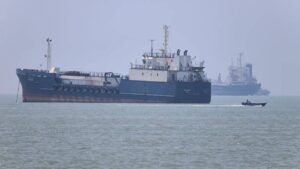
The Pakistani army announced that Army Commander Field Marshal Asim Munir held discussions with Iranian officials in Tehran, focusing on ways to prevent further escalation in the region, in addition to discussing reopening the Strait of Hormuz to shipping traffic.
The Pakistani army said, in a statement on Tuesday, that Munir discussed during his meetings “regional peace and ways to reach a settlement of disputes through negotiation,” without revealing additional details about the results reached.
Munir’s visit to Tehran coincided with a Pakistani move to revive the negotiating track between the United States and Iran, as Pakistani Interior Minister Mohsin Naqvi is also participating in the talks.
Naqvi said that his country had made “significant progress” in its discussions with the Iranian leadership, noting that the two sides were discussing reactivating the Islamabad Memorandum of Understanding, which aims to provide a framework for settling the conflict between Washington and Tehran.
He added that the meeting with Iranian President Masoud Pezeshkian ended “at a very positive point,” explaining that the talks addressed the tensions in the Middle East and the path required to reach peace, in addition to the steps necessary to reactivate the memorandum of understanding.
The Pakistani moves come in light of faltering negotiations between the United States and Iran, amid disagreements related to the Iranian nuclear file and security and navigation files, and at a time when the Strait of Hormuz remains a major axis in ongoing communications, given its importance to trade movement and global energy supplies.
During the past months, Pakistan has played a role in bringing views between Washington and Tehran closer, and hosted meetings aimed at pushing towards a settlement of the conflict. Islamabad also continued to communicate with the two parties in an attempt to relaunch the stalled negotiating path.
In parallel with the Pakistani diplomatic move, the United States intensified its economic pressure on Iran, as US Treasury Secretary Scott Besent announced an expansion of the scope of sanctions and warned against imposing secondary sanctions on entities and countries that continue to deal with Tehran.
The US Treasury Department said that the new measures target networks linked to five main sectors that Iran uses to support its economy, which are digital assets, technology, gold, aviation, and maritime shipping, while the new sanctions included about 60 people, entities, and ships linked to Iran.
Besant warned that those who facilitate financial transactions for Iran may face US measures, while he said that Washington is working to put pressure on the channels that Tehran uses to generate revenues and circumvent sanctions.
On the other hand, Iranian Economy Minister Ali Madani Zadeh announced his country’s readiness to confront US sanctions, in conjunction with the continuation of contacts aimed at finding a negotiated way out of the crisis.
The focus on the Strait of Hormuz comes in light of the strategic importance of the sea lane, which represents one of the most prominent energy transport routes globally, which makes any disruption to shipping traffic in it have direct repercussions on shipping movement and energy markets.
Pakistan seeks, through its current movements between Tehran and Washington, to return the parties to the negotiating table and prevent the expansion of the scope of escalation, while the results of the communications remain linked to the ability of the two sides to overcome the outstanding differences and reach understandings on the issues in dispute.