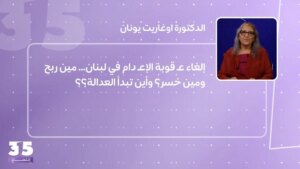
“Lebanon Debate”
The head of the “Lebanese Forces” party, Samir Geagea, turned his defense of the withdrawal of his representatives from the general amnesty session into an open confrontation with a number of Sunni representatives, after he described some of them as “monkeys” during his talk about those who boycotted the session and those who attended it.
In his interview on Radio Free Lebanon, Geagea denied that the “Forces” had obstructed the amnesty law, and said that representatives of the “Strong Republic” bloc withdrew to prevent the adoption of a wrong and partial formula that did not take into account the amendments demanded by the majority of Sunni representatives.
But Geagea, while explaining his position, described some of the representatives who chose to attend the session as “monkeys,” moving the discussion from responsibility for disrupting the quorum to a direct political insult that targeted elected representatives.
Representative Ahmed Rustom responded violently, considering that Geagea’s words were not a slip of the tongue, but rather a “decline in political discourse” that does not befit the leader of a party who is supposed to be responsible and respectful.
Rustom said that political disagreement is a legitimate right, but resorting to insults against representatives representing a wide segment of the Lebanese people reveals an inability to confront the other opinion with argument and logic.
He added: “The dignity of Sunni representatives is the dignity of all Lebanese, and it should not be the subject of insult or abuse. Low speech only offends those who deliver it, and those who are unable to combat political positions with argument resort to personalization and insults.”
Rustom also accused Geagea of “swinging positions, breaking promises, and launching positions that contradict yesterday’s actions,” considering that these practices are what deserve to be held accountable before public opinion.
Representative Walid Al-Baarini entered the line of response, recalling Geagea’s release from prison under an amnesty law, and said on the “X” platform: “Whoever was released from prison with a pardon should have appreciated the value of the tolerance granted to him by the Sunni street, not distribute insults, lecture on morals, and continue with treachery at all important stations.”
He added: “Political disagreement should be confronted with arguments, not insults. As for us, we will remain loyal to our convictions and our people, and we will not be intimidated by descriptions or campaigns.”
The confrontation reveals the “forces’” predicament after the parliamentary session. Geagea said that his representatives withdrew in defense of the formula demanded by the majority of Sunni representatives, but in return he attacked Sunni representatives who did not adhere to the same political reading.
Thus, instead of Geagea succeeding in closing the issue of obstructing the amnesty session, he opened a new confrontation with Akkar’s representatives, and turned a law that was supposed to lift injustice and relieve tension into an additional material for division.