The confrontation between the United States and Iran in the Strait of Hormuz is heading towards a long and potentially volatile path, coinciding with the monitoring of worrying Iranian activity inside a new enrichment facility that may be more fortified than the Fordow facility, amid estimates that Tehran does not show any willingness to back down and that the decision to expand the battle has become linked to US President Donald Trump.
According to a report published by Radio 103FM, Iran and the United States continue to exchange attacks in the Strait of Hormuz, with the intensity of the confrontation escalating in recent days.
In this context, Danny Citrinovic, a researcher in Iranian affairs and the Shiite axis at the National Security Research Institute, spoke during an interview with Gideon Okko and Amichai Atali on Radio 103FM, about the recent exchange of strikes between Washington and Tehran, and the growing tension in the Strait of Hormuz.
Citrinovic explained that the Iranians, in his estimation, will not back down this time, and said: “Ultimately, the campaign that we launched to weaken the Iranian regime and rob it of the ability to access a nuclear weapon is currently focused on an event that did not exist before the war. The Strait of Hormuz was open before the war, but now the main focus of the current confrontation has become an attempt to control or decide who will have control over the Strait.
He added: “On the Iranian side, I do not see any desire to retreat. I think the Iranians will go to the end in this confrontation, as this is the price they have to pay to maintain control of the Strait of Hormuz. Even if the situation continues like this, they will not back down, and this presents Trump with a dilemma regarding whether he will eventually back down. “I do not see that the Iranian side has any willingness to settle.”
Speaking about the nature of the current confrontation, he said: “We are in a battle to control the Strait of Hormuz, and neither party wants to concede. The Americans issue warnings to the Iranians to open the strait, and in return the Iranians close it, then the Americans attack and the Iranians respond.”
He continued: “The confrontation could end either with one of the parties retreating, or with reaching an agreement between Iran and Oman, or with a formula regulating traffic in the strait, or with events getting out of control.”
He added: “As we talked yesterday, the attacks are currently aggressive, but the geographical location and the nature of the targets indicate that each party seems to want to preserve the possibility of returning to negotiations. As long as the confrontation continues at this pace, it will be difficult to maintain the framework and prevent further escalation.”
He pointed out that the confrontation is currently focused in the Strait of Hormuz, adding: “The two parties are working within some kind of rules of the game, but the situation could certainly get out of control.”
According to Citrinovic, the American attacks aim to weaken the Iranian threat in Hormuz, while the Iranians, for their part, have drawn their red line.
He said: “There are conflicting reports indicating that the Americans are continuously attacking the Iranian capabilities used to strike the Strait of Hormuz, including command facilities, radars, and launch pads, while the Iranians are widely attacking American bases in the Gulf region.”
He pointed out that Iran is not attacking the UAE or Saudi Arabia, adding: “Most of the strikes are concentrated in southern Iran and the coastal region, meaning it is an attempt to weaken Iran’s ability to target oil tankers.”
The report attached a photo from Reuters showing oil tankers and cargo ships in the Strait of Hormuz, along with a photo of the Iranian flag from Arab networks.
Citrinovic considered that the US strikes would not completely prevent Iran from targeting shipping, and said: “This will not prevent them from striking, because one missile is enough to prevent the crossing of an oil tanker, and this is the basic problem.”
He added: “With regard to petrochemical facilities, the Iranians have made it clear that if the infrastructure is targeted, they will respond by striking the infrastructure.”
He continued, speaking about the possibility of preserving the chances of negotiations: “Trump, from the American point of view, may be saying: I can hit all the bridges, but I do not do that because I want to preserve the chance of reaching an agreement.”
He added: “Let’s see if these reports are true, because if they are true, the Iranians will inevitably retaliate against the infrastructure in the Gulf region.”
Citrinovic warned that the confrontation may last a long time, saying: “This may accompany us for a long period, days and even weeks.” Last week, there were reports that the American goal is to run a campaign that will last weeks, until the Iranians weaken or surrender.
He added: “The problem is that we are in the Middle East, and events can get out of control. “We are in a situation where both parties are fighting, and each of them wants to maintain its sovereignty and ability to control the strait, and they do not want to cross the lines or close the door to negotiations.”
He explained that Qatar and Oman are working hard behind the scenes to prevent escalation, adding: “But if petrochemical facilities are targeted, that changes the situation for the Iranians.” Currently, both parties do not want escalation, but this situation may accompany us for many days and weeks.”
Regarding the possibility of Israel entering the front line, Citrinovic said: “Israeli intervention is what will expand the campaign. “I do not think that there is a desire in Washington for Israel to enter the confrontation, because that will turn it into a regional event, and will make it very difficult for the Americans to return to negotiations.”
He added: “I am sure that Netanyahu is not sad because of what is happening currently, but everything depends on Trump.”
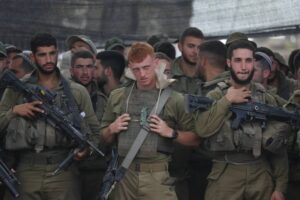
The report also attached a photo of Israeli Air Force crews on their way to carry out a strike in Iran, citing an Israeli army spokesman.
The conversation then moved to the Iranian nuclear program, where Oko asked the researcher whether Iran was taking advantage of this period to progress in achieving its nuclear ambitions.
Citrinovic responded: “Satellite images show conclusively that Iran is preparing something, certainly in the context of enrichment.”
When Oko asked him: “Does this really appear in the pictures?” Citrinovic replied: “When you look at Iran’s movements, you see that it is carrying out work in that region, inside a new enrichment facility that Iran had announced, and it may be more difficult to target than Fordo.”
He added: “Iran is doing things there, and this is a worrying development, because we have no oversight. We have been without oversight for a year, in a situation where the IAEA is not there…we should be concerned. The important thing is the nuclear file, and that is where the focus must remain at all times.
At the conclusion of the interview, Oko asked about uranium, and the possibility of Iran moving towards producing a nuclear weapon at a military level, saying: “Are there pictures showing that Iran has returned to uranium enrichment?”
Citrinovic answered firmly: “The pictures show work being carried out in the area.” We must remain focused on what is happening with the Iranian nuclear program. “What appears in satellite images are things that should worry us greatly.”
Between the battle to control the Strait of Hormuz and the mysterious activity inside the new enrichment facility, the confrontation appears to be facing two parallel tracks, one of which is military and open to weeks of escalation, and the other is nuclear, progressing away from oversight, while the decision to curb or expand them remains dependent on Trump’s next step.