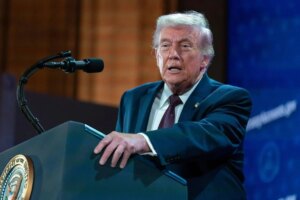
At the conclusion of the G7 summit, US President Donald Trump presented his version of the path of the agreement with Iran, placing Tehran in the position of the party ready to sign after receiving a severe blow, and at the same time sending striking messages to Israel, Netanyahu, and Lebanon, in a speech that combined threats, military boasting, and defense of the evolving settlement.
According to a report by journalist Eli Leon in Maariv, on the last day of the G7 summit, Trump held a meeting with Indian Prime Minister Narendra Modi, and launched a series of positions regarding negotiations with Tehran, the situation in the Middle East, and fighting alongside Israel. In the summit’s closing speech, Trump revealed that Israel refused to participate in the assassination of Qassem Soleimani, even though it was a partner in preparing for the operation. He also said that “the agreement will be signed tomorrow or Friday,” and that “we sent Israel the memorandum of understanding.”
Trump said at the conclusion of the summit: “Thank you to President Macron and his wife. The G7 summit was the most successful and at an excellent time following the agreement with Iran. We prevented Iran from obtaining a nuclear weapon. They cannot develop or buy a nuclear weapon. The stock market is breaking records, and the price of oil is falling dramatically. If we had not completed the deal, we could have bombed Iran for weeks and years, but we would not have succeeded in opening the Strait of Hormuz. I killed Soleimani, who was a crazy genius.”
Trump added: “The leaders are excited about the deal. Only fools wanted us to keep bombing Iran. The Iranians have new, smart leadership. They are less radical. They love their country. Many of their leaders were killed. I didn’t want to see an economic disaster. Every time we got close to a peace agreement, the stock market went up, and if we said otherwise, it went down. I didn’t want to end up like President Herbert Hoover.”
He continued: “All the leaders issued statements in support of the agreement. If we had continued the bombing, what would have remained? The strait would not have been opened due to fear of missiles flying over it.”
In an indirect criticism of Israel, Trump returned to the assassination of Soleimani, saying: “No one was crueler than me, because I killed Soleimani, who was a crazy genius, and the father of side bombs. Israel did not want to participate in the assassination of Soleimani. The plan was shared between us and the Israelis. We knew that he was on a plane, then the Israelis told us that they were not interested. But we killed Soleimani nonetheless.”
Trump then went on to talk about the agreement and the partnership with Israel, and said: “The Prime Minister of Pakistan told me that this was one of the big moves. Obama would not have done that. He filled planes with cash that was flown to Iran. Netanyahu is a very good man, but sometimes he gets too excited. This is an excellent partnership. They are the small partners and we are the big ones. Netanyahu begged Obama not to sign the terrible deal for Israel. I canceled that deal. The agreement will be signed soon, tomorrow or Friday. We sent Israel the memorandum of understanding. Israel was “It can do a better job on the Hezbollah issue.”
Trump stressed, “We will not allow them to obtain a nuclear weapon. They have enriched uranium underground, and B-2 planes have destroyed the facilities. No one touches the uranium. We are watching them from space. If anyone gets close we can spot them. Iran has agreed not to buy or develop a nuclear weapon. Whoever sells a nuclear weapon to Iran will be bombed with a nuclear weapon himself. I feel bad for the Lebanese. Over the last 50 years they have been crushed.”
Regarding the Strait of Hormuz, Trump said: “Our blockade was like an iron wall. Maritime traffic has increased dramatically, and markets will rise. Tactical talks will begin soon, and unlike Obama, we will not transfer money to them. We can invest in Iran because we have caused them about a trillion and a half trillion dollars in damage. We will not give them money. The current leaders in Iran are fine.”
During his meeting with Modi, when asked about a possible agreement with Iran, Trump stressed that Tehran is in a position of unprecedented weakness. He said: “Deals are an amazing thing, and I have made them all my life. They want to sign, they want to return to a normal life. We hit them with great force.” He recalled the assassination of Qassem Soleimani, and bragged about the destruction of the Iranian army, saying: “They do not have a navy, they do not have an air force, everything was bombed. The first and second levels of their leadership were killed. They are very ready to make a deal.”
However, Trump did not hesitate to issue a clear ultimatum, as he said that if the Iranians backed away from the current negotiating understandings, “We will start the process again, and we are not losing. We have the greatest army in the world.” He used the platform to attack the nuclear agreement signed under President Obama, describing it as “the stupidest agreement I have ever seen, and it paved the way to a nuclear weapon.”
When asked about Israel and tensions in the Middle East, and whether he wanted Israel to stop its military campaign, his answer was decisive: “No. I want Israel to be able to defend itself, but I also want them to use sound judgment.” Although he did not mention Prime Minister Benjamin Netanyahu by name in this answer, the message to decision-makers in Israel seemed clear and direct.
A remarkable moment was recorded when Trump decided to praise his Indian counterpart, Narendra Modi, in his own style, saying: “Look at this man. He is the most beautiful man. He seems very gentle, like an angel. But in reality, he is cruel. He is a killer,” referring to his negotiating abilities. He also promised full US military support for India, saying: “If anyone attacks this man, we will be there to help.”
In parallel with Trump’s statements, and on the last day of the G7 summit held in the French resort of Evian-les-Bains, the leaders of France and Japan sent political messages related to global hotspots of tension.
French President Emmanuel Macron addressed the situation in the Middle East, stressing that it is of paramount importance that Iran, Hezbollah and Israel do not return to fighting. Macron also expressed his support for the ongoing contacts regarding a preliminary agreement between the United States and the Islamic Republic of Iran, aimed at ending the confrontation between the two parties. “This is a good agreement, and it is an agreement that we support,” he said, in an attempt to give the diplomatic track international impetus.
In another file within the summit, Japanese Prime Minister Sanae Takaichi spoke about American involvement in the Asian arena and the balance of power with Beijing. During a press conference, Takaichi rejected fears of a possible American withdrawal from the region, stressing that she does not believe that US interest in the Indo-Pacific region is declining.
Takaichi explained that she held talks with US President Trump on this issue, noting that Japan confirmed during the meeting that Tokyo and Washington will continue close and strategic coordination regarding the situation in the Indo-Pacific region, including dealing with and monitoring China.
Between Trump’s talk about an imminent agreement with Iran, Netanyahu’s description of him as “a good man” but “too enthusiastic,” and his reference to Lebanon and Hezbollah, the G7 summit appeared to be a platform for announcing a new phase: Washington wants calm on its terms, and asks its allies to read the limits of the new role as it sees it.