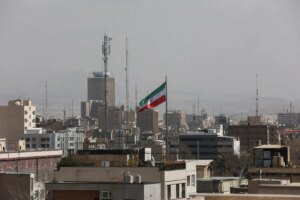
In a new escalation that heralds the expansion of the confrontation in the region, the US army on Wednesday evening launched military strikes on targets inside Iran for the second night in a row, in a move that Washington says is aimed at pushing Tehran to accept an agreement, while fears increase that the situation will slide into a broader confrontation that may affect US bases and vital sea lanes in the Gulf.
According to a report by journalist Barak Ravid on the Axios website, American officials confirmed that the new strikes came within the framework of increasing pressure on Iran to return to the negotiating table on American terms, but at the same time they acknowledged that these operations entail the risk of direct military escalation.
American officials said that they were expecting an Iranian response, which might target American bases, as happened on Tuesday. In this context, Tehran announced on Wednesday evening that its forces had targeted, with drones, the US Fifth Fleet stationed in Bahrain in response to the recent US strikes, without it being immediately clear whether these attacks had hit their targets.
US President Donald Trump had accused Iran of “dealing with us as if we were fools” during the negotiations, considering that it was time to take different steps.
The US Central Command (CENTCOM) announced that the strikes, which targeted “multiple targets inside Iran,” began at 5:15 p.m. US East Coast time and lasted about 4 hours, noting that they came in response to what it described as “continuous and unjustified Iranian aggression.”
The report quoted a US official as saying that all the targets were located in southern Iran, and included air defense systems, radar systems, and drone command and control units.
Before carrying out the operation, US Defense Secretary Pete Hegseth said during a visit to the US Central Command headquarters in Florida, “Central Command will be busy tonight because we will strike Iran hard.”
He added: “Iran has an opportunity to conclude a wonderful agreement, but it was not prepared for that,” continuing: “Successive bombs will be dropped on major facilities in Iran by the United States. The goal is not to reignite the war, but rather to impose the terms of the agreement.”
He also said: “If we have to negotiate with bombs, we will negotiate with bombs. We will hit them hard tonight and we hope that Iran will make the right decision.”
The report indicated that Trump held a meeting on Wednesday afternoon with his national security team to discuss military options, hours after he announced to reporters that the United States “will strike them again forcefully today,” according to two American sources.
Shortly after nine o’clock in the evening Eastern time, the US Central Command announced via the “X” platform that the military operation had ended.
She said in a statement: “Forces from the US Marine Corps, the US Air Force, and the US Navy used precision munitions against Iranian targets that posed a threat to US forces and international trade ships crossing territorial waters.”
On the other hand, the Iranian “Tasnim” agency quoted a military source as confirming that the Iranian response would be “heavy.”
Although the results of the Iranian drone attack on the Fifth Fleet are not clear, the Bahraini Ministry of Interior announced that sirens sounded in the country.
Earlier Wednesday, the Iranian president considered that Trump’s threats did not express force but rather “desperation.”
On Tuesday evening, the United States targeted Iranian radar and air defense sites in response to the downing of an American helicopter, while ensuring that the strikes were limited to prevent human casualties and keep the door open to reaching an agreement.
Iran then responded by launching a relatively limited number of missiles and drones towards American bases.
The report also revealed that Trump met on Wednesday with Vice President J.D. Vance, Secretary of State Marco Rubio, CIA Director John Ratcliffe, Chairman of the Joint Chiefs of Staff General Dan Cain, and White House envoy Steve Witkoff, while Hegseth participated in the meeting via call from Central Command headquarters.
Two American sources indicated that one of the options that Trump was considering was to implement a large-scale but short-term operation, with the aim of pushing Iran to change its position in the negotiations, without revealing additional details.
According to the report, Trump has been growing increasingly frustrated over the past two weeks due to Iran’s delay in responding to the latest American offer made to it, which prompted the US administration to move from a policy of waiting to a policy of direct military pressure, in a new test of the equation of power and negotiation in one of the most sensitive arenas in the Middle East.