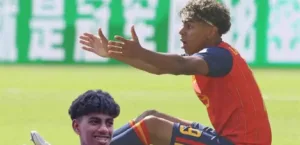
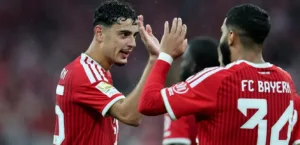
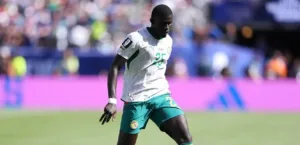
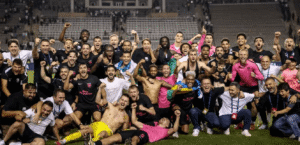
The 2026 World Cup is witnessing a remarkable phenomenon represented by the participation of a number of brothers defending the colors of different national teams, in an image that reflects the increasing influence of immigration and the intersection of national identities in modern football.
The most prominent of these cases are the two sisters, Desiree and Gila Dowie. Both players were born in France, but their international paths took different directions.
While Desiree Douy, the rising star of Paris Saint-Germain, wears the France national team shirt, his older brother Gila chose to represent the Côte d’Ivoire national team, their father’s country of origin, where he plays the right-back position.
It also highlights the story of the two brothers, Inaki and Nico Williams, who were born in the Spanish Basque Country to Ghanaian parents.
Nico Williams achieved widespread fame after he won the Best Player award in the final match of the European Championship when he led Spain to victory over England two years ago.
As for his older brother, Inaki Williams, who turns 32 next week, he played only one friendly match with the Spanish national team, which later allowed him to change his sporting nationality and join the Ghana national team, which represents his family’s roots.
Ghana’s squad also includes defender Derek Lucassen, born in the Netherlands, who was called up at the last minute to the World Cup squad to replace an injured player, thus joining his half-brother Brian Brobbey, who plays for the Netherlands national team.
Brobbie (24 years old) is considered one of the attacking options in the ranks of the Dutch national team after his brilliance during the second half of last season with Sunderland in the English Premier League. The two players share the same mother, while the father is different.
In another case, Australia chose defender Harry Souttar, who was born in the Scottish city of Aberdeen, while his older brother John Souttar represents the Scotland national team.
Although the two brothers were born in Scotland, their mother is Australian, which allowed Harry to change his sporting nationality 7 years ago after representing the Scottish national teams in the age groups.
Gila Doy told reporters after the match: “Of course, we exchanged some jokes and jokes before the match. In the end, we are one family and we are very happy for each other.”
The story of the Douy brothers carries special dimensions, as the two players began their career together at the French Academy of Rennes. However, Desiree’s exceptional talent pushed him to shine even more, and he moved to Paris Saint-Germain and became one of the most prominent emerging talents in European football.
Reuters notes that the waves of immigration that Europe has witnessed over the past decades have contributed to providing a wide reservoir of talent for African teams, which increasingly depend on members of communities residing abroad.
Teams such as Algeria, Morocco, Senegal, Tunisia, Cape Verde and the Democratic Republic of the Congo include a large number of European-born players on their rosters participating in the tournament.
Despite the many cases of siblings representing different teams, the history of the World Cup witnessed only one case in which two brothers faced each other on the field, and this happened twice in a row.
In the 2010 World Cup in South Africa, German defender Jerome Boateng faced his older half-brother, Ghanaian player Kevin-Prince Boateng, and the match ended with Germany winning 1-0 in Johannesburg.
The confrontation between them was renewed four years later in the World Cup in Brazil, when the two teams met again in Fortaleza and the match ended in a 2-2 draw.
Jerome Boateng recalled the memories of those confrontations, saying: “It was certainly special, but it seemed somewhat different after 4 years.”
He added: “In 2010, it was completely new and exceptional. I don’t want to say that it has become familiar, because the World Cup can never be familiar, but we played against each other many times in the German League.”
The stories of siblings competing in the World Cup remain one of the most attention-grabbing human stories, as they combine family ties and different national affiliations, and confirm how football has become a clear mirror of human movement and cross-border migration in today’s world.