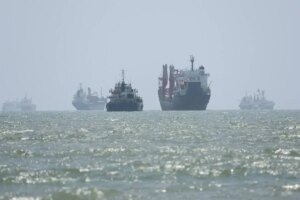
In one of the most violent rounds of direct confrontation between the United States and Iran in recent months, an American operation targeting an Iranian oil tanker turned into the spark of a widespread military escalation in the Gulf, which included attacks with drones and ballistic missiles and exchanged strikes on sensitive military targets.
The crisis began when American forces detected what they described as an attempt to breach the naval blockade imposed on Iranian ports. US Central Command says that the “Lexi” oil tanker, which has been on US sanctions lists since last March after it was accused of transporting millions of barrels of Iranian oil, was heading towards the oil facility on Kharg Island.
Central Command announced that an American plane fired a Hellfire missile that directly hit the tanker’s engine room, completely disabling it before it reached its destination.
The Iranian response was not delayed. According to American officials, Tehran launched suicide drones towards civilian ships that were crossing the Gulf, which prompted American forces to shoot down 3 drones over territorial waters.
At the same time, the United States carried out what it described as “defensive strikes” against Iranian military command and control stations on Qeshm Island, located at the entrance to the Strait of Hormuz, one of the most important sea lanes for global energy trade.
With the destruction of the command sites on the island, Iran escalated its operations by launching ballistic missiles towards Kuwait and Bahrain, where American military bases are located.
But the US Central Command confirmed that the attack completely failed, explaining that two missiles launched towards Kuwait fell or disintegrated before reaching their targets, while 3 other missiles heading towards Bahrain were intercepted by US and Bahraini defense systems.
On the other hand, the Iranian Revolutionary Guard accused Washington of igniting the confrontation by targeting the “Lexi” tanker, announcing that its forces responded to what it described as “American aggression” and targeted sites belonging to the “American-Zionist enemy.” He also confirmed that the attacks were in response to the destruction of a military communications tower on Qeshm Island.
However, the US Central Command categorically denied the Iranian story, stressing that the headquarters of the US Fifth Fleet in Bahrain was not subjected to any casualties, and that all Iranian attacks on US forces failed.
She said in a statement: “American forces successfully thwarted multiple attacks by Iranian ballistic missiles and drones, and no American personnel were harmed. As for Iranian claims about targeting the headquarters of the Fifth Fleet, they are false.”
This escalation comes after a series of direct military confrontations over the past few days, which included American strikes inside Iranian territory and Iranian responses to bases and sites linked to the American military presence in the region.
The transition of the confrontation from a proxy war to an exchange of direct strikes between Washington and Tehran reflects an unprecedented level of tension, amid growing fears that the Gulf will turn into an open battleground that goes beyond the limits of traditional military messages.