“If you love Lebanon, love its industry,” a phrase that was not just a slogan, but rather an expression of a basic idea that the strength of any country stems from its production and its ability to rely on itself. Over the years, this phrase has been associated with a Lebanese industry that was able to prove its presence, based on the quality of its production and efficiency despite various crises.
But the reality today is different from what it was when that campaign was launched. The industrial sector, which was one of the pillars of economic resilience, is today facing increasing pressure and successive crises, which have worsened with the repercussions of the recent war.
In this context, Vice President of the Industrialists Association, Ziad Bakdash, explained in an interview with Lebanon 24, that “the 2026 war caused the greatest damage to the economic sector in general, and especially to the industrial sector, as Lebanon was still trying to recover from the repercussions of the 2024 war when the new war broke out, which exacerbated the scale of the crisis and burdened the economic and industrial institutions.”
Absence of financial support and disruption of financing mechanisms
He pointed out that previous wars witnessed support from the banking sector for economic sectors, while this support is completely absent today, explaining that “corporate financing has become dependent on sales only, and with their decline, it becomes difficult to secure the raw materials needed to continue production.”
Production shrinkage and factory closures
Bakdash revealed that the industrial sector declined by about 50%, pointing out that a large number of factories located in hot areas closed their doors, while luxury factories in safe areas recorded a decline in sales ranging between 80 and 90%. He added that the food industry sector, despite being the most active during wars, is no longer operating at the same production capacity due to the decline in citizens’ purchasing power, as demand has become limited to basic goods without luxuries.
Regarding direct damage, he stressed that the Industrialists Association has not yet received information about the complete destruction of factories affiliated with it, but that some factories in unsafe areas suffered partial damage.
Workers are stuck between stopping and reducing salaries
He explained that “workers and employees always remain the weakest link,” noting that completely closed factories in unsafe areas stopped working, while many workers left those areas, which made it difficult to communicate between them and the factory departments. He added that some factories have stopped paying salaries in full due to the complete closure, while other factories are resorting to paying half a salary for a limited period, but they are unable to continue doing so in light of the ambiguity of when the war will end.
He stressed that “the greatest concern is the duration of the war and the timing of its end,” pointing to concerns related to the ability of factories to continue, secure employee salaries, pay suppliers’ dues, and maintain production flow, especially since about 30% of the Lebanese market was greatly affected by the war. He added that some factories that are still operating at an acceptable pace are now paying salaries in two or three installments.
As for the food industries, he explained that restaurants and hotels constitute the primary customers for this sector, but the sharp decline in tourist traffic has had a negative impact on food factories.
Loss of foreign markets and high shipping costs
Bakdash pointed out that the crisis is no longer limited to the local market, but has extended to foreign markets as well, explaining that the Arab and Gulf countries are among the most prominent markets that receive Lebanese exports, in addition to the European and American markets.
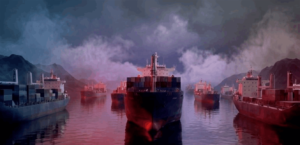
He pointed out that the Gulf and Arab countries are also witnessing an economic decline and a decline in purchasing power, in addition to a decline in tourism activity, which has prompted many importers to freeze or cancel their orders and limit themselves to basic needs only. The significant increase in the cost of shipping and insurance against war risks also contributed to weakening the competitiveness of Lebanese products and raising the production cost.
He explained, “The cost has risen significantly. A container that used to be shipped from Beirut to Kuwait cost $2,500. Today, it costs about $6,500, which has practically led to the loss of the Gulf market.” He added that European markets are also suffering from an economic slowdown and a decline in demand by about 50%, which means that Lebanon is gradually losing export markets, in conjunction with a stifling crisis in the local market, which explains the impact of the war on the industrial sector reaching 50%.
He concluded by confirming that the import and export movement is still continuing despite all the difficulties, noting that logistical alternatives are still available, as the port of Tripoli can be relied upon in the event of the closure of the port of Beirut, and land crossings with Syria can be used in the event of a naval blockade or the closure of the ports.
In conclusion, the industrial sector today is facing a critical stage that is testing its ability to withstand in light of mounting economic pressure and the repercussions of war that have affected various aspects of production. Between the current challenges and attempts to adapt, the future of the Lebanese industry remains dependent on the extent of the stability of the situation and its ability to restore its balance and role in the national economy.