In light of the escalation of Israeli attacks on Lebanon, the issue of ceasefire and general amnesty returned to the forefront of political and legislative debate, at a time when Parliament Speaker Nabih Berri intensified his meetings in Ain al-Tineh, following up on political and field developments, in addition to urgent legislative files.
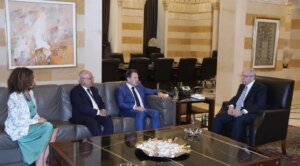
In this context, Berri received the Minister of Agriculture, Nizar Hani, where they discussed the general situation and the latest developments, in addition to the repercussions of the Israeli aggression on the agricultural sector and farmers. Hani briefed the President of the Council on the extent of the losses inflicted on the agricultural sector and forest areas, noting that the percentage of damage amounted to about 22.5%, equivalent to 56,264 hectares, distributed among olive groves, fruit trees, tobacco, citrus, bananas, and protected crops, in addition to the direct repercussions on the Lebanese economy.
Berri also followed up on political developments and legislative affairs during his meeting with the Chairman of the Finance and Budget Committee, MP Ibrahim Kanaan, who stressed after the meeting that “the first concern of all Lebanese is to establish a ceasefire,” considering that Lebanon is experiencing “disasters” and that the main way out of them is to establish stability.
Kanaan stressed that “the Lebanese path is the beginning of Lebanon’s rights to its stability, borders, and land,” noting Berri’s keenness on national unity and putting a final end to “this daily tragedy.” He added that any progress on this path will be directly reflected in the financial, economic and social issues that the Lebanese are suffering from.
Kanaan concluded by stressing that “what protects us currently is our unity, and the unity of our position on our rights, on the stability of our country, and on supporting our army and our legitimacy,” calling for no division over these issues at the current stage.
In the afternoon, Berri received a delegation from the “National Moderation” bloc, which included Representatives Muhammad Suleiman, Ahmed Al-Khair, and Abdulaziz Al-Samad, in the presence of former Representative Hadi Hobeish and Representative Ali Hassan Khalil, where the meeting discussed the political and field conditions, the file of the displaced, in addition to the general amnesty law.
Representative Abdul Aziz Al-Samad confirmed after the meeting that the discussion addressed “the necessity of approving the general amnesty law due to its humanitarian and national dimensions,” noting that Berri confirmed the call for a joint committee session on Monday, which would contribute to alleviating tension and addressing the issue within the framework of law and justice.
Al-Samad stressed his rejection of the Israeli attacks and repeated violations of Lebanese sovereignty, stressing full adherence to the “Taif Agreement” and the necessity of its full implementation, as “the only guarantee for the Lebanese state, the regular functioning of institutions, and the promotion of national stability and coexistence.”
For his part, MP Ahmed Al-Khair explained that the goal of the joint committee session is to agree among the political blocs on proposing an amnesty law and passing the controversial provisions, stressing that the file is related to two basic issues: “justice and addressing the overcrowding crisis in prisons.”
Al-Khair pointed out that Interior Minister Ahmed Al-Hajjar described the file as a “time bomb,” which holds MPs responsible for completing it as quickly as possible.
In response to the controversy related to the Baabda meeting, Al-Khair stressed that the role of the President of the Republic was not to interfere in legislation, but rather to “bridge the gap” between some representatives and the military institution on specific points related to the military institution, stressing that “the real legislation will be in Monday’s session.”
He added: “The statement issued by the Sunni representatives confirms that a general amnesty for us is a strategic goal that cannot be reversed,” considering that Berri’s invitation to the joint committee session reflects his keenness for the decision to be decided within the constitutional institutions, expressing his confidence that “Monday will be a good day.”