Subhi Amhaz – Middle East
Israeli statements about the goals of the war in southern Lebanon are accompanied by military measures that all indicate that the war will last for a long time, as Israel seeks to bring about demographic change and remove villages, in preparation for imposing a future occupation reality, in exchange for indications from Hezbollah that it is preparing for a long battle as a result of developing its combat tools, according to experts.
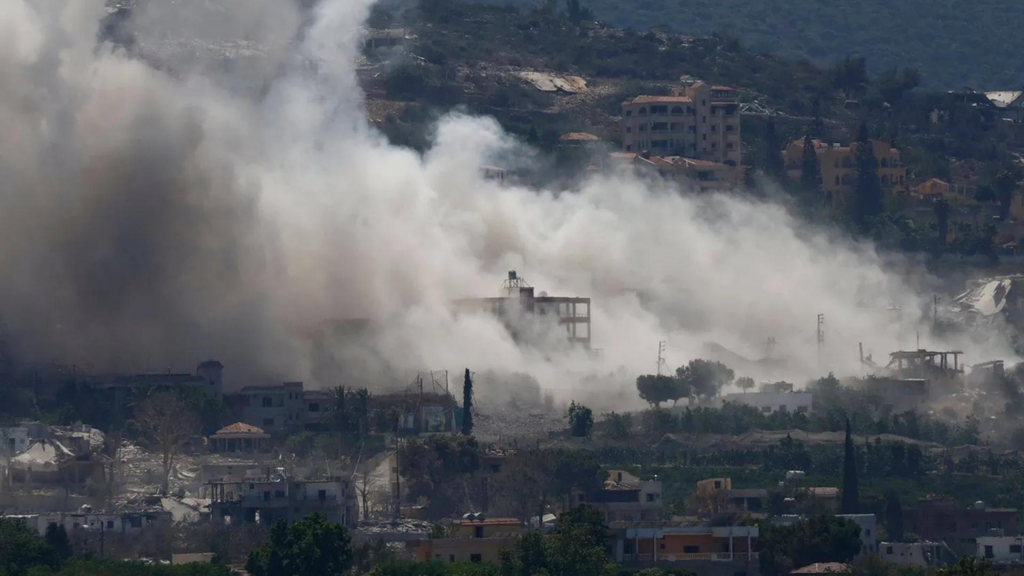
Israeli discussions about intentions to expand beyond the south of the Litani, to avoid a war of attrition, show American restrictions on the Israeli military operation that expands by fire to the villages of the Nabatieh and Tire districts, that is, a distance exceeding 30 kilometers away from the border, which is seen in Beirut as a tool of pressure on the Lebanese state and the Hezbollah environment.
The “yellow line”…a long-term withdrawal
In a military interpretation of this reality, retired Brigadier General Saeed Qazah confirmed to Asharq Al-Awsat that “Israeli withdrawal from the buffer zone defined by what is known as the (yellow line) in southern Lebanon will not happen easily, or unilaterally,” suggesting that this will be “linked to clear security understandings, which in terms of framework may resemble previous agreements that included field arrangements between the two sides similar to the armistice agreement.”
Qazah said that Israel “will not give up this region for free, but rather will seek to use it as a pressure card on the Lebanese government,” considering that the goal goes beyond the military dimension to include “concluding a final agreement with the Lebanese state, and pressuring (Hezbollah) to surrender its weapons.”
He believed that the situation on the ground is likely to escalate further, adding: “The relative truce that exists in some areas will not continue, as any direct negotiating path between Lebanon and Israel may be met with an escalation on the ground that leads to its collapse, and any security incident, even limited, could ignite the front again.”
New tools
He pointed out that technological developments on the battlefield, especially the use of drones, “increase the complexity of the scene,” considering that “any qualitative operation, even if limited, may lead to a wide turn in the confrontation, especially if it inflicts large human losses, which may prompt Israel to respond on a large scale.”
He pointed out that the possibilities of the conflict expanding are not limited to the Lebanese interior, but are also linked to regional developments, saying: “Any potential confrontation between Iran and the United States could be directly reflected on the southern front, and push towards reigniting it, or rather complicating it.”
He stressed that “the duration of the Israeli forces’ stay in the buffer zone will remain subject to political and security understandings,” stressing that “without a clear agreement that guarantees the security of northern Israel, there will be no rapid withdrawal, which opens the door to a phase that may resemble, in some aspects, pre-2000.”
Goals go beyond destruction to redrawing facts
For his part, retired Brigadier General Naji Malaeb conveyed in a statement to Asharq Al-Awsat a detailed reading of the Israeli goals, considering that “what the Israeli is doing today, despite the multiple and sometimes ambiguous statements, clearly reveals his intentions through the positions of his Prime Minister Benjamin Netanyahu, especially in light of the presence of a public American guarantee and support that allows him to use force under the roof of political protection.”
Malaeb said: “We are facing a situation that goes beyond the issue of destruction itself, as what is happening inside the so-called “yellow line” is a process of removing landmarks and settling scores with (Hezbollah), in addition to draining it, but the main goal is three things: First: consolidating what is known as the yellow zone, which is not limited to land, but extends to the sea opposite Naqoura, which practically leads to dropping Lebanon’s right to the Qana field, and dropping the 2022 maritime demarcation agreement, so that this area becomes under control. “Israel, allowing it to begin exploration without adhering to the agreement.”
He added: “Second: There is an intention to annex areas extending towards the course of the Litani River, especially in the nearby areas that are not more than two or three kilometers from the border, which is reflected in the bombings that affected villages located beyond the course of the river, and within the scope of the Yellow Line, which opens the way for achieving an old goal for Israel, which is seeking to control the Litani waters.”
He continued: “Thirdly: When Netanyahu talks about an area extending from the sea to Mount Hermon, he means expanding the scope of control to include the entire area, including countless areas within Hezbollah’s environment that have not witnessed direct fighting, within the framework of a security project based on placing this area extending from the occupied Golan to the sea under Israeli control.”
Demographic concerns
Malaeb considered that “the destruction occurring does not achieve an actual military goal, as destroying a few kilometers does not provide protection for northern Israel, because the range of missiles and drones far exceeds that, which makes this military logic invalid.”
He added: “What is actually happening is an attempt to bring about demographic change and remove villages in preparation for imposing a future occupation reality if Israel is allowed to expand and establish its presence.”
Regarding the American role, he said: “The statements issued by the American embassy about Lebanon restoring its sovereignty and reconstruction remain conditional, as the actual position of the American administration links any negotiating results to ending the war with Iran and stopping its interference in Lebanon through Hezbollah, which means that all promises remain suspended on this path.”