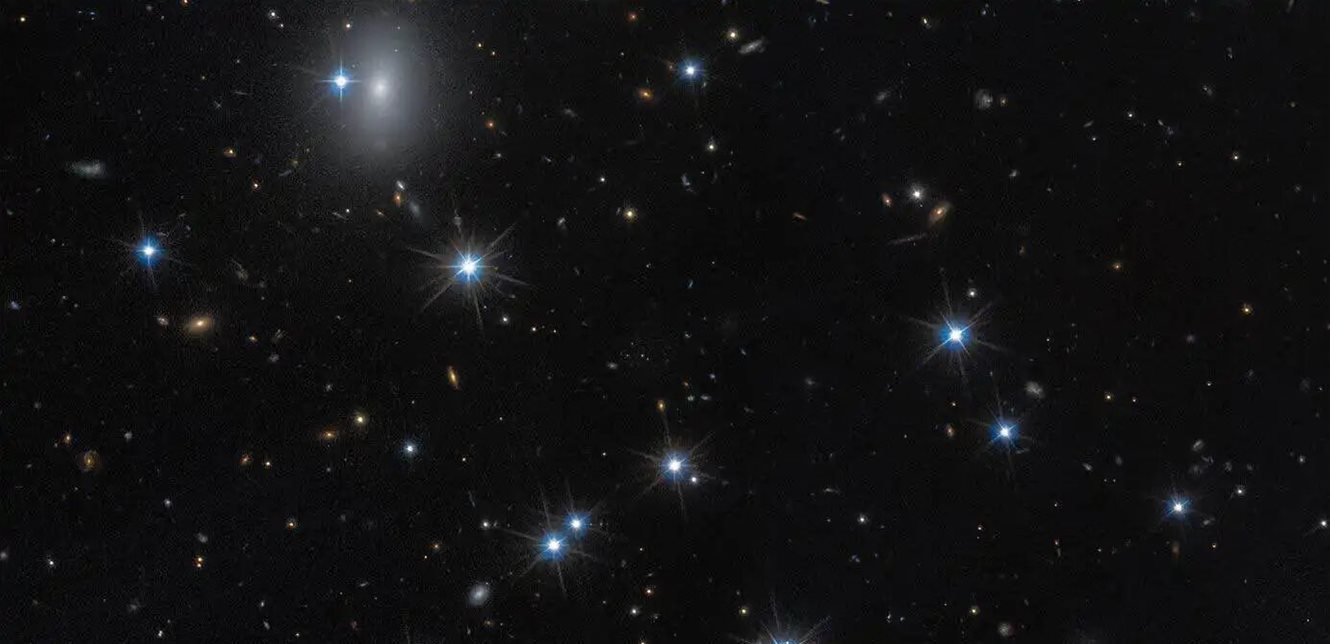
The US space agency NASA announced the discovery of a new and rare galaxy, named CDG-2, or “Candidate Dark Galaxy 2.” This galaxy is almost invisible, as it is composed almost entirely of dark matter, according to a study published in the Astrophysical Journal Letters.
NASA explained that these galaxies, which are called “low surface brightness,” contain very few faint stars, making them nearly impossible to see. Dark matter makes up a large percentage of the galaxy’s mass, about 99%, including visible matter, which is a number worth noting.
“Technically, CDG-2 is a semi-dark galaxy, but it brings us much closer to what we thought was the range of total darkness, where a galaxy cannot be that faint,” Dai Li, the study’s lead author, told CNN.
Scientists believe that the number of stars in CDG-2 is very small, with visible elements representing only 16% of the galaxy’s content. These visible objects often consist of globular clusters containing tens of thousands to millions of stars, according to the European Space Agency.
Analyzes indicate that a significant portion of the matter needed for star formation has been lost as a result of gravitational interactions with other galaxies within the Perseus Cluster. It also indicates that dark matter is responsible for maintaining the cohesion of globular clusters in the galaxy.
Yaoyuanmao, a professor of physics and astronomy at the University of Utah, called the discovery “very exciting,” adding that the faint, diffuse light seen in the Hubble Telescope images confirms that CDG-2 is a coherent object and not just a random alignment of globular clusters.
The discovery of CDG-2 is an important step toward understanding dark matter, one of the most mysterious components of the universe. This discovery also allows scientists to study how galaxies form in the absence of prominent stars. (seventh day)