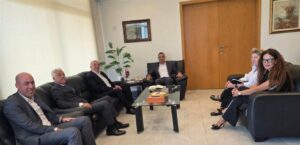
Under the patronage of the Minister of Agriculture, Dr. Nizar Hani, represented by the Director General of Cooperatives, Eng. Gloria Abu Zeid, the third conference organized by the Koura Development Council, under the title “Developing the Agricultural Sector in Koura,” was held at the Koura Development Council Center – Amioun.
The conference was attended by representatives: Fadi Karam, Adeeb Abdel Masih, George Atallah, President of the Federation of Koura Municipalities, Engineer Malek Fares, Brigadier General Dr. Elie Karam, representing the President of the University of Balamand, Dr. Elias Warraq, President of the Association of Mayors of Koura, Shadi Masih, mayors and mayors, farmers, and interested parties.
After a welcome speech from the pharmacist Shawqi Al-Shamas, the head of the conference, the head of the Koura Development Council, Elie Darwish, presented the council’s activities, which included publishing a number of awareness books on agriculture in Koura, especially since the land of Koura is rich in water. He also explained that “the land adjacent to the development center, which amounts to 2,000 square meters, has been reclaimed to use it as a Korean market in which farmers sell their produce, because working on the land strengthens the Korani’s affiliation to its land.” He extended his greetings to the Council’s founder, Dr. George. “Jaha.”
Knight
The head of the Union of Koura Municipalities delivered a speech in which he greeted the audience and said: “Your presence, His Excellency the Minister, among us today is a message of support and confidence for the Al-Kourani farmer who, despite all the challenges, still clings to his land and believes that agriculture is not just a profession, but rather an identity, belonging and a message of life. Koura, as you know, was historically known for olive cultivation until the olive tree became a symbol of its land and a symbol of the steadfastness of its people. This blessed tree was not only an economic resource, but a source of dignity.” And live generously. Today, we are all called to protect and develop this heritage by modernizing production methods, improving quality, supporting agricultural industrialization, and opening new markets for our products, which constitutes an essential step to protect the agricultural seasons and reflects positively on the local economy and national food security. Developing the agricultural sector in Koura requires an integrated plan based on giving this vital sector the necessary attention and supporting it directly by the Ministry of Agriculture, by: Providing appropriate medicines to combat the widespread agricultural diseases that affect crops, and providing the necessary chemicals to nourish trees and maintain their growth And its continuity. What is also important is to focus as much as possible on effective agricultural extension that keeps pace with scientific development * as well as strengthening cooperation between the municipalities, their union, and the Ministry of Agriculture to launch sustainable projects, out of our belief that the partnership between the state, municipalities, and the private sector is the best way to bring about a qualitative shift in this sector and reduce immigration by providing job opportunities for our youth and restoring their vital role.”
He addressed the minister’s representative and said: “We are counting on your ministry’s generous support to place Koura at the heart of the national agricultural strategy because of its natural and human capabilities that qualify it to be a model for sustainable agricultural production. We place all these demands in your hands, hoping for a quick response for the good of farmers and society as a whole. In conclusion, we affirm that our towns in Koura will remain an active partner in every initiative aimed at developing the land and people because we believe that investment in agriculture is an investment in the survival of our people on their land.” And their homeland.”
Abu Zaid
Abu Zeid then conveyed in her speech the minister’s greetings and said: “I am honored to convey to you the greetings of His Excellency the Minister of Agriculture, Dr. Nizar Hani, and his appreciation for this initiative, which reflects a development awareness based on scientific planning and participatory dialogue to advance the agricultural sector in the Koura District, this region that has distinct environmental characteristics and a long agricultural history, especially in the cultivation of olives and Mediterranean crops. The development of the agricultural sector today is no longer just a matter of quantitative production, but has become a complex process based on the management of natural resources.” Efficiently, improving sustainable productivity, enhancing added value and raising competitiveness within integrated value chains.”
She added: “Any scientific vision for the advancement of agriculture in Koura must start from the rational management of soil and water. Soil fertility is not a fixed given, but rather a dynamic biological system that is affected by agricultural patterns, the quality of fertilizers, and the management of agricultural waste. Therefore, adopting fertilization programs based on periodic laboratory analyses, the balance between chemical and organic fertilizers, and introducing agricultural practices that preserve the soil, are all essential elements for maintaining productivity in the long term, and preventing land degradation or depletion. Also, confronting The challenges of climate change require the adoption of modern irrigation techniques, the selection of varieties adapted to local conditions, and the application of climate-smart agricultural practices that reduce risks and enhance production stability. The development of the agricultural sector in Koura cannot be achieved through isolated individual efforts, but rather through effective regulatory frameworks, most notably agricultural cooperatives. Cooperatives, when managed according to the principles of good governance, transparency, and accountability, constitute a strategic tool for reducing the cost of inputs and organizing the sorting, packing, and storage processes. Improving negotiation conditions in markets, and unifying standards to ensure product quality and stability. From an economic perspective, investing in cooperatives is an investment in sustainability, because it enhances farmers’ resilience and transforms them from individual producers into organized economic actors within integrated value chains.”
She continued: “The Ministry of Agriculture, through its competent directorates, especially the General Directorate of Agriculture and the General Directorate of Cooperatives, works to strengthen agricultural extension based on knowledge and scientific research, support governance within cooperatives and build their administrative and financial capabilities, develop partnerships with municipalities, their unions and academic institutions, and direct support towards sustainable productive projects with a tangible economic and social impact. We believe that successful agricultural development is built in partnership and is based on accurate data, clear performance indicators and continuous monitoring and evaluation mechanisms. In conclusion, Al Koura has The natural and human components to be a national model for high-quality sustainable agriculture. What we need today is to move from diagnosis to implementation, and from separate initiatives to a clearly defined, integrated vision. On behalf of His Excellency the Minister of Agriculture, I confirm the Ministry’s commitment to keeping pace with the recommendations of this conference, and to work with all partners to transform agriculture in Koura into a more productive, more sustainable sector, and more capable of creating added value and promoting food sovereignty together, towards a fair and sustainable agricultural development that is based on knowledge, respects the environment and serves people.”
Lectures
The head of the North Lebanon Agriculture Department, Engineer Sonia Al-Abyad, gave the first lecture, which dealt with the role of the General Directorate of Agriculture in serving agriculture and farmers in the Koura district.
Head of the Department of Cooperation in the North, Engineer Allegania Makhoul, presented the role of cooperative societies in managing operations to increase crop production.
In the third lecture, the head of the Agriculture Department at the Issam Fares College of Technology at the University of Balamand, Dr. Rodrigue Balaa, emphasized the possibility of agricultural and food industrialization.